
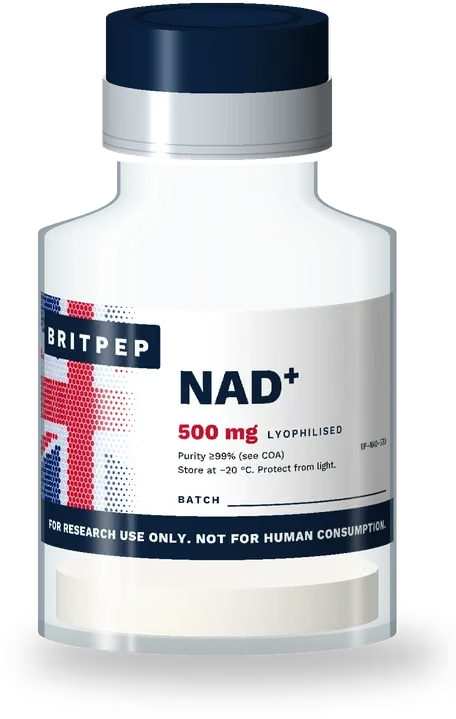
NAD⁺
Nicotinamide adenine dinucleotide (oxidised form), an essential redox cofactor used in enzymology and metabolism research.
Prepared to order · approx. 7 days + Royal Mail Tracked 24
SKU BP-NAD-500 · ≥99% (see COA) · Lyophilised powder
NAD⁺ overview
β-NAD⁺ is the oxidised form of nicotinamide adenine dinucleotide. It is a standard biochemical reagent, not a peptide, and is supplied as a lyophilised solid for in-vitro research.
NAD⁺ research background
Evidence status: This compound is an established biochemical reagent; findings summarised here come from published biochemical, cell, animal and (where stated) human research. They are not established effects in humans, have not been evaluated by the MHRA, and are provided for scientific context only. This product is supplied strictly for laboratory research and is not for human or veterinary use.
Established research
Peer-reviewed published findings, with referencesOverview & discovery history
Chemical identity
Identity values are confirmed per lot on the certificate of analysis. Salt/counter-ion form (e.g. acetate or TFA) is stated on the COA where applicable.
Mechanisms investigated
Research areas & model types
Human clinical research status
- Most human research concerns NAD⁺ precursors rather than NAD⁺ itself [2]. NAD⁺ is not an approved medicine in the UK.
Safety observations reported in studies
- Reviews note that the long-term safety of raising NAD⁺ levels in humans is not established [1].
Known limitations
- Animal findings on NAD⁺ repletion have not been established in humans [1].
Storage & handling for laboratory use
Store at −20 °C. Protect from light.
Store lyophilised material sealed at −20 °C or below, protected from light and moisture. Allow the vial to equilibrate to room temperature before opening to limit condensation.
- Allow the sealed vial to reach room temperature before opening to limit condensation.
- Any solutions should be prepared only for in-vitro laboratory work under your own validated protocol; aliquoting limits repeated freeze–thaw cycles.
- Handle with standard laboratory PPE in line with your risk assessment and the Safety Data Sheet (SDS). Britpep does not provide preparation or administration guidance.
Emerging & theoretical
Unconfirmed — hypotheses & ongoing researchThese are unconfirmed hypotheses and early-stage lines of enquiry, not established effects. Not evaluated by the MHRA. Not for human or veterinary use.
Hypotheses proposed by researchers
- Researchers have proposed that age-related NAD⁺ decline contributes to age-related disease, and that restoring NAD⁺ is a potential research avenue [3][1].
Registered clinical studies (ongoing or unpublished)
- NCT07839130 — Phase 2 randomised placebo-controlled PEDI-NAD trial of NAD⁺ in paediatric cardiac dysfunction (sponsor: Beijing Children's Hospital). Listed as not yet recruiting.
- NCT06558253 — Exploratory Phase 1 study of 'coenzyme I' (NAD⁺) in haematopoietic recovery after cord-blood transplantation (sponsor: Anhui Provincial Hospital). Listed as recruiting.
Registry entries checked on ClinicalTrials.gov on 24 October 2026; status as listed by the sponsor. Registration does not imply results or efficacy.
Open scientific questions
- Is NAD⁺ decline a cause or a consequence of ageing phenotypes?
Preprints: none included (no relevant preprint could be verified). Anecdotal, user-reported or social-media material is deliberately excluded.
References
- Covarrubias AJ, Perrone R, Grozio A et al.. NAD(+) metabolism and its roles in cellular processes during ageing. Nat Rev Mol Cell Biol. 2021. PubMed 33353981 · doi:10.1038/s41580-020-00313-x
- Migaud ME, Ziegler M, Baur JA. Regulation of and challenges in targeting NAD(+) metabolism. Nat Rev Mol Cell Biol. 2024. PubMed 39026037 · doi:10.1038/s41580-024-00752-w
- Rajman L, Chwalek K, Sinclair DA. Therapeutic Potential of NAD-Boosting Molecules: The In Vivo Evidence. Cell Metab. 2018. PubMed 29514064 · doi:10.1016/j.cmet.2018.02.011
- Garten A, Schuster S, Penke M et al.. Physiological and pathophysiological roles of NAMPT and NAD metabolism. Nat Rev Endocrinol. 2015. PubMed 26215259 · doi:10.1038/nrendo.2015.117
Every reference was checked against PubMed (NCBI) before publication. Summaries describe published research only and are not claims of any effect in humans or animals.
Certificates of analysis
[No batch COA published yet. The certificate for each lot will be listed here and in the COA checker before release.]
Related research compounds
5-Amino-1MQ
AICAR
AOD9604
Glutathione (reduced)
Browse similar compounds: Mitochondrial & metabolic biochemistry research compounds or the full catalogue.