
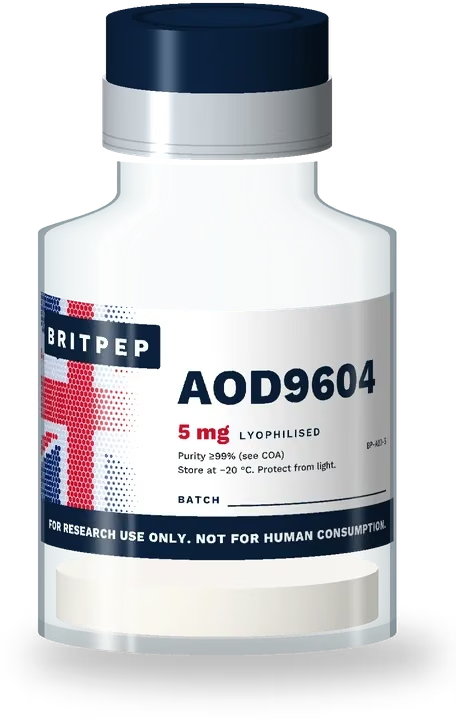
AOD9604
Modified C-terminal fragment (residues 176–191) of human growth hormone, studied in lipid-metabolism research.
Prepared to order · approx. 7 days + Royal Mail Tracked 24
SKU BP-AOD-5 · ≥99% (see COA) · Lyophilised powder
Note: Salt form (e.g. acetate or TFA) and net peptide content to be confirmed from the supplier COA.
AOD9604 overview
AOD9604 is a 16-residue synthetic peptide based on the C-terminal region (176–191) of human growth hormone, with an additional N-terminal tyrosine. It is supplied as a lyophilised solid for in-vitro laboratory research.
AOD9604 research background
Evidence status: Findings summarised here come from preclinical research and small, early-phase human studies. They are not established effects in humans, have not been evaluated by the MHRA, and are provided for scientific context only. This product is supplied strictly for laboratory research and is not for human or veterinary use.
Established research
Peer-reviewed published findings, with referencesOverview & discovery history
- AOD9604 is a modified C-terminal fragment of human growth hormone (residues 176–191, with an added N-terminal tyrosine). It was developed by Metabolic Pharmaceuticals (Australia) as a potential anti-obesity agent and reached Phase II trials [1].
Chemical identity
Identity values are confirmed per lot on the certificate of analysis. Salt/counter-ion form (e.g. acetate or TFA) is stated on the COA where applicable.
Mechanisms investigated
Research areas & model types
Human clinical research status
- Phase II trials in obesity were reported in an industry development review [1]. Full peer-reviewed Phase II results were not located in PubMed. AOD9604 is not an approved medicine.
Safety observations reported in studies
- Compared with hGH, it had no adverse effect on insulin sensitivity in obese rats [4].
Known limitations
- The primary clinical results have not been published in peer-reviewed form.
Storage & handling for laboratory use
Store at −20 °C. Protect from light.
Store lyophilised material sealed at −20 °C or below, protected from light and moisture. Allow the vial to equilibrate to room temperature before opening to limit condensation.
- Allow the sealed vial to reach room temperature before opening to limit condensation.
- Any solutions should be prepared only for in-vitro laboratory work under your own validated protocol; aliquoting limits repeated freeze–thaw cycles.
- Handle with standard laboratory PPE in line with your risk assessment and the Safety Data Sheet (SDS). Britpep does not provide preparation or administration guidance.
Emerging & theoretical
Unconfirmed — hypotheses & ongoing researchThese are unconfirmed hypotheses and early-stage lines of enquiry, not established effects. Not evaluated by the MHRA. Not for human or veterinary use.
Hypotheses proposed by researchers
- Researchers have proposed that hGH behaves as a 'pro-hormone' whose fragments have distinct activities [2].
Preprints: none included (no relevant preprint could be verified). Anecdotal, user-reported or social-media material is deliberately excluded.
References
- Wilding J. AOD-9604 Metabolic. Curr Opin Investig Drugs. 2004. PubMed 15134286
- Heffernan MA, Thorburn AW, Fam B et al.. Increase of fat oxidation and weight loss in obese mice caused by chronic treatment with human growth hormone or a modified C-terminal fragment. Int J Obes Relat Metab Disord. 2001. PubMed 11673763 · doi:10.1038/sj.ijo.0801740
- Heffernan M, Summers RJ, Thorburn A et al.. The effects of human GH and its lipolytic fragment (AOD9604) on lipid metabolism following chronic treatment in obese mice and beta(3)-AR knock-out mice. Endocrinology. 2001. PubMed 11713213 · doi:10.1210/endo.142.12.8522
- Ng FM, Sun J, Sharma L et al.. Metabolic studies of a synthetic lipolytic domain (AOD9604) of human growth hormone. Horm Res. 2000. PubMed 11146367 · doi:10.1159/000053183
Every reference was checked against PubMed (NCBI) before publication. Summaries describe published research only and are not claims of any effect in humans or animals.
Certificates of analysis
[No batch COA published yet. The certificate for each lot will be listed here and in the COA checker before release.]
Related research compounds
5-Amino-1MQ
AICAR
CJC-1295 (with DAC)
CJC-1295 (without DAC)
Browse similar compounds: Endocrine & receptor-signalling research peptides, Mitochondrial & metabolic biochemistry research compounds or the full catalogue.