
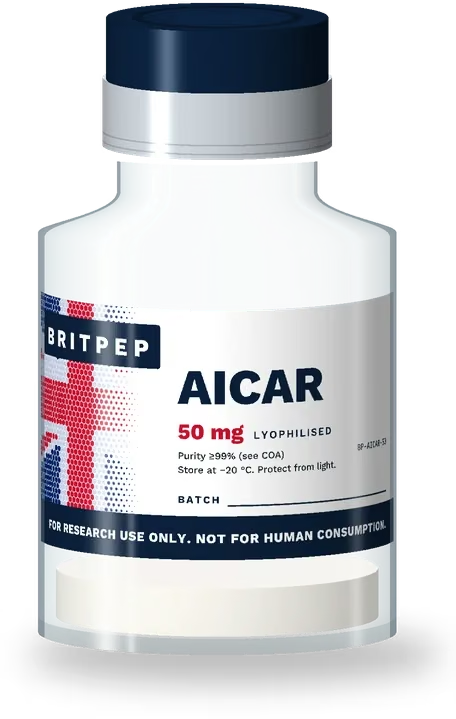
AICAR
Adenosine analogue (AICA-riboside) widely used as an AMPK activator in cell-biology research.
Prepared to order · approx. 7 days + Royal Mail Tracked 24
SKU BP-AICAR-50 · ≥99% (see COA) · Lyophilised powder
AICAR overview
AICAR (5-aminoimidazole-4-carboxamide ribonucleoside, acadesine) is a cell-permeable nucleoside. It is a standard laboratory tool compound and not a peptide. It is supplied as a lyophilised solid for in-vitro research.
AICAR research background
Evidence status: AICAR is an established laboratory tool compound; findings summarised here come from cell and animal research and from historical human trials (as acadesine) with mixed results. They are not established effects in humans, have not been evaluated by the MHRA, and are provided for scientific context only. This product is supplied strictly for laboratory research and is not for human or veterinary use.
Established research
Peer-reviewed published findings, with referencesOverview & discovery history
- AICAR (5-aminoimidazole-4-carboxamide ribonucleoside, acadesine) is a nucleoside, not a peptide. Since the mid-1990s it has been a standard tool for activating AMP-activated protein kinase (AMPK) in intact cells [1][2]. Under the name acadesine, it was developed clinically as an adenosine-regulating agent for ischaemia–reperfusion injury in cardiac surgery [3][4][5].
Chemical identity
Identity values are confirmed per lot on the certificate of analysis. Salt/counter-ion form (e.g. acetate or TFA) is stated on the COA where applicable.
Mechanisms investigated
- Cells take it up and phosphorylate it to ZMP, an AMP analogue that activates AMPK, leading to inhibition of fatty-acid and sterol synthesis in hepatocytes [1].
- A 2021 systematic review highlighted important AMPK-independent effects of AICAR that complicate its use as a specific AMPK activator [2].
- Its disposition and metabolism have been characterised [6].
Research areas & model types
Human clinical research status
Safety observations reported in studies
- Safety in the perioperative trials was reported within those study settings [5].
Known limitations
- Its AMPK-independent effects complicate interpretation [2].
Storage & handling for laboratory use
Store at −20 °C. Protect from light.
Store lyophilised material sealed at −20 °C or below, protected from light and moisture. Allow the vial to equilibrate to room temperature before opening to limit condensation.
- Allow the sealed vial to reach room temperature before opening to limit condensation.
- Any solutions should be prepared only for in-vitro laboratory work under your own validated protocol; aliquoting limits repeated freeze–thaw cycles.
- Handle with standard laboratory PPE in line with your risk assessment and the Safety Data Sheet (SDS). Britpep does not provide preparation or administration guidance.
Emerging & theoretical
Unconfirmed — hypotheses & ongoing researchThese are unconfirmed hypotheses and early-stage lines of enquiry, not established effects. Not evaluated by the MHRA. Not for human or veterinary use.
Hypotheses proposed by researchers
- Researchers have proposed AMPK activators as 'exercise mimetics' based on mouse data [7].
Open scientific questions
- Which reported effects are truly AMPK-dependent?
Preprints: none included (no relevant preprint could be verified). Anecdotal, user-reported or social-media material is deliberately excluded.
References
- Corton JM, Gillespie JG, Hawley SA et al.. 5-aminoimidazole-4-carboxamide ribonucleoside. A specific method for activating AMP-activated protein kinase in intact cells? Eur J Biochem. 1995. PubMed 7744080 · doi:10.1111/j.1432-1033.1995.tb20498.x
- Višnjić D, Lalić H, Dembitz V et al.. AICAr, a Widely Used AMPK Activator with Important AMPK-Independent Effects: A Systematic Review. Cells. 2021. PubMed 34064363 · doi:10.3390/cells10051095
- Drew BG, Kingwell BA. Acadesine, an adenosine-regulating agent with the potential for widespread indications. Expert Opin Pharmacother. 2008. PubMed 18671468 · doi:10.1517/14656566.9.12.2137
- Mangano DT. Effects of acadesine on myocardial infarction, stroke, and death following surgery. A meta-analysis of the 5 international randomized trials. The Multicenter Study of Perioperative Ischemia (McSPI) Research Group. JAMA. 1997. PubMed 9002496 · doi:10.1001/jama.277.4.325
- Newman MF, Ferguson TB, White JA et al.. Effect of adenosine-regulating agent acadesine on morbidity and mortality associated with coronary artery bypass grafting: the RED-CABG randomized controlled trial. JAMA. 2012. PubMed 22782417 · doi:10.1001/jama.2012.7633
- Dixon R, Fujitaki J, Sandoval T et al.. Acadesine (AICA-riboside): disposition and metabolism of an adenosine-regulating agent. J Clin Pharmacol. 1993. PubMed 8227467 · doi:10.1002/j.1552-4604.1993.tb01929.x
- Narkar VA, Downes M, Yu RT et al.. AMPK and PPARdelta agonists are exercise mimetics. Cell. 2008. PubMed 18674809 · doi:10.1016/j.cell.2008.06.051
- [No authors listed]. Effects of acadesine on the incidence of myocardial infarction and adverse cardiac outcomes after coronary artery bypass graft surgery. Multicenter Study of Perioperative Ischemia (McSPI) Research Group. Anesthesiology. 1995. PubMed 7574044 · doi:10.1097/00000542-199510000-00004
Every reference was checked against PubMed (NCBI) before publication. Summaries describe published research only and are not claims of any effect in humans or animals.
Certificates of analysis
[No batch COA published yet. The certificate for each lot will be listed here and in the COA checker before release.]
Related research compounds
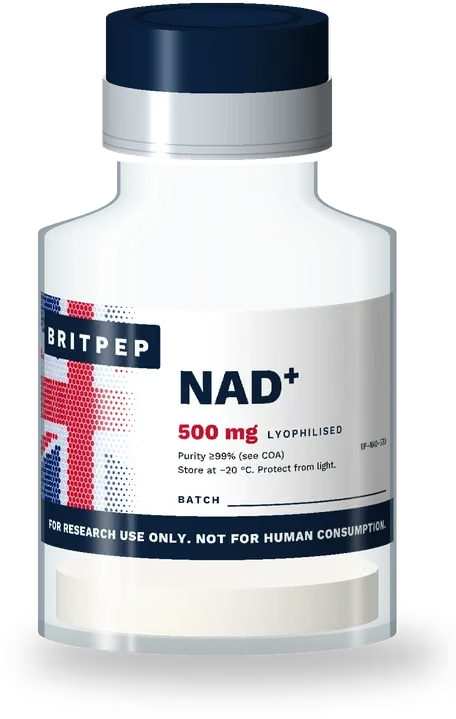
Browse similar compounds: Mitochondrial & metabolic biochemistry research compounds or the full catalogue.