
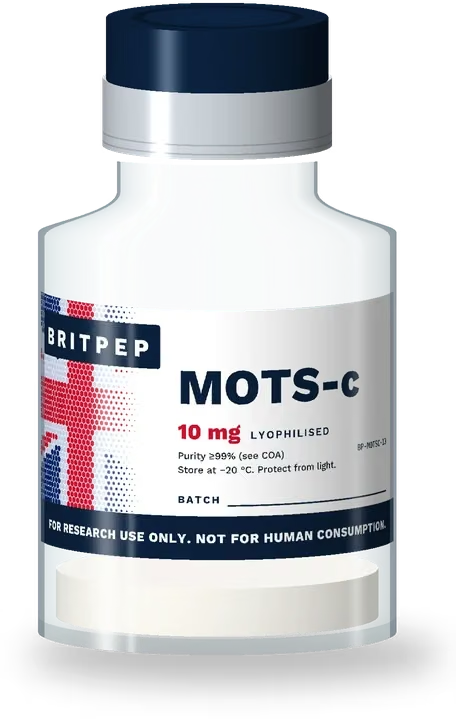
MOTS-c
16-residue mitochondrial-derived peptide encoded in the 12S rRNA region of mtDNA, used in metabolic biochemistry research.
Prepared to order · approx. 7 days + Royal Mail Tracked 24
SKU BP-MOTSC-10 · ≥99% (see COA) · Lyophilised powder
MOTS-c overview
MOTS-c (mitochondrial open reading frame of the 12S rRNA type-c) is a mitochondrially encoded peptide. It is supplied as a lyophilised solid for in-vitro research.
MOTS-c research background
Evidence status: Findings summarised here come from published research, much of it preclinical (cell or animal), with only very small or uncontrolled human reports. They are not established effects in humans, have not been evaluated by the MHRA, and are provided for scientific context only. This product is supplied strictly for laboratory research and is not for human or veterinary use.
Established research
Peer-reviewed published findings, with referencesOverview & discovery history
Chemical identity
Identity values are confirmed per lot on the certificate of analysis. Salt/counter-ion form (e.g. acetate or TFA) is stated on the COA where applicable.
Mechanisms investigated
- Folate cycle and AMPK: in cells, MOTS-c inhibited the folate cycle and linked de novo purine biosynthesis, leading to AICAR accumulation and AMPK activation [1].
- Nuclear translocation: under metabolic stress MOTS-c translocated to the nucleus in an AMPK-dependent manner and regulated nuclear genes, including antioxidant-response-element genes, interacting with NRF2 [4].
Research areas & model types
| Research area | Model type | Summary |
|---|---|---|
| Diet-induced and age-related insulin resistance | Mouse | [1] |
| Physical capacity in young, middle-aged and old animals | Mouse | [6] |
| Cold adaptation and thermogenesis | Mouse | [7] |
| Endogenous expression after exercise | Human (observational) | Exercise increased endogenous MOTS-c in skeletal muscle and circulation [6]. |
Human clinical research status
- No completed, published interventional trial of MOTS-c was identified. It is not an approved medicine. A 2023 review noted that no established method of clinical application had been developed [5].
Safety observations reported in studies
- No human safety data from interventional studies were identified.
Known limitations
- This is a young field (since 2015), with much of the work from the originating group and its collaborators [5].
Storage & handling for laboratory use
Store at −20 °C. Protect from light.
Store lyophilised material sealed at −20 °C or below, protected from light and moisture. Allow the vial to equilibrate to room temperature before opening to limit condensation.
- Allow the sealed vial to reach room temperature before opening to limit condensation.
- Any solutions should be prepared only for in-vitro laboratory work under your own validated protocol; aliquoting limits repeated freeze–thaw cycles.
- Handle with standard laboratory PPE in line with your risk assessment and the Safety Data Sheet (SDS). Britpep does not provide preparation or administration guidance.
Emerging & theoretical
Unconfirmed — hypotheses & ongoing researchThese are unconfirmed hypotheses and early-stage lines of enquiry, not established effects. Not evaluated by the MHRA. Not for human or veterinary use.
Hypotheses proposed by researchers
- Researchers have proposed that mitochondrial and nuclear genomes co-evolved to cross-regulate each other through peptides such as MOTS-c [4].
- Reviews hypothesise roles in ageing and metabolic disease [5][3].
Registered clinical studies (ongoing or unpublished)
- NCT07505745 — Phase 2a randomised placebo-controlled study in adults with prediabetes and overweight/obesity (sponsor: Hudson Biotech). Listed as recruiting.
Registry entries checked on ClinicalTrials.gov on 24 October 2026; status as listed by the sponsor. Registration does not imply results or efficacy.
Open scientific questions
- What is the receptor or uptake mechanism for extracellular MOTS-c?
Preprints: none included (no relevant preprint could be verified). Anecdotal, user-reported or social-media material is deliberately excluded.
References
- Lee C, Zeng J, Drew BG et al.. The mitochondrial-derived peptide MOTS-c promotes metabolic homeostasis and reduces obesity and insulin resistance. Cell Metab. 2015. PubMed 25738459 · doi:10.1016/j.cmet.2015.02.009
- Lee C, Kim KH, Cohen P. MOTS-c: A novel mitochondrial-derived peptide regulating muscle and fat metabolism. Free Radic Biol Med. 2016. PubMed 27216708 · doi:10.1016/j.freeradbiomed.2016.05.015
- Mohtashami Z, Singh MK, Salimiaghdam N et al.. MOTS-c, the Most Recent Mitochondrial Derived Peptide in Human Aging and Age-Related Diseases. Int J Mol Sci. 2022. PubMed 36233287 · doi:10.3390/ijms231911991
- Kim KH, Son JM, Benayoun BA et al.. The Mitochondrial-Encoded Peptide MOTS-c Translocates to the Nucleus to Regulate Nuclear Gene Expression in Response to Metabolic Stress. Cell Metab. 2018. PubMed 29983246 · doi:10.1016/j.cmet.2018.06.008
- Zheng Y, Wei Z, Wang T. MOTS-c: A promising mitochondrial-derived peptide for therapeutic exploitation. Front Endocrinol (Lausanne). 2023. PubMed 36761202 · doi:10.3389/fendo.2023.1120533
- Reynolds JC, Lai RW, Woodhead JST et al.. MOTS-c is an exercise-induced mitochondrial-encoded regulator of age-dependent physical decline and muscle homeostasis. Nat Commun. 2021. PubMed 33473109 · doi:10.1038/s41467-020-20790-0
- Lu H, Tang S, Xue C et al.. Mitochondrial-Derived Peptide MOTS-c Increases Adipose Thermogenic Activation to Promote Cold Adaptation. Int J Mol Sci. 2019. PubMed 31109005 · doi:10.3390/ijms20102456
Every reference was checked against PubMed (NCBI) before publication. Summaries describe published research only and are not claims of any effect in humans or animals.
Certificates of analysis
[No batch COA published yet. The certificate for each lot will be listed here and in the COA checker before release.]
Related research compounds
Browse similar compounds: Mitochondrial & metabolic biochemistry research compounds or the full catalogue.