Two meanings of “mitochondrial peptide”
The term is used for two unrelated classes of molecule. Mitochondria-targeted peptides are synthetic compounds designed to accumulate in mitochondria; the Szeto–Schiller (SS) peptides are the best-known example [1]. Mitochondrial-derived peptides are endogenous peptides encoded by short open reading frames within the mitochondrial genome; MOTS-c is one of them [6][7]. They have different origins, different structures and different research questions.
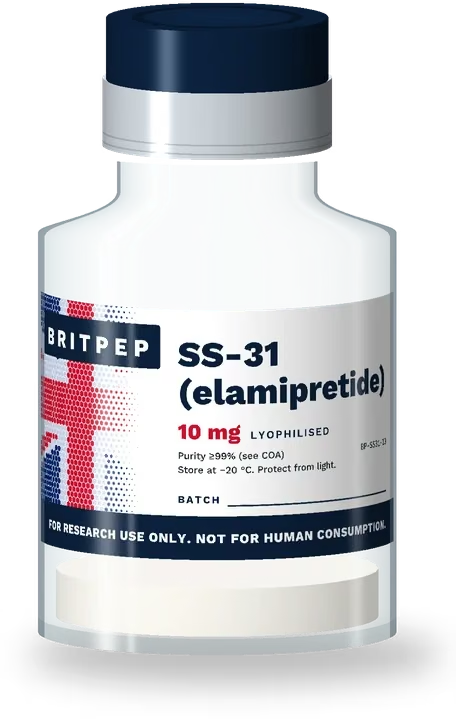
SS-31 (elamipretide)
SS-31 is a tetrapeptide, D-Arg-Dmt-Lys-Phe-NH2, where Dmt is 2′,6′-dimethyl-L-tyrosine. The alternating aromatic and basic residues give it a positive charge at physiological pH, and it was described as a cell-permeable, mitochondria-targeted peptide that concentrates in the inner mitochondrial membrane [1].
Cardiolipin. A 2013 study in rat kidney reported that SS-31 interacts with cardiolipin, a phospholipid characteristic of the inner mitochondrial membrane, and re-energised ischaemic mitochondria [4]. A 2025 review summarises its structure and proposed mechanism [2].
Clinical development. Under the name elamipretide, SS-31 has been studied in clinical trials. The MMPOWER-3 Phase 3 trial in primary mitochondrial myopathy did not meet its primary endpoints [5]. In September 2025 elamipretide received accelerated approval in the US for Barth syndrome [3]. It does not have a UK marketing authorisation, and research-grade SS-31 is not a medicine.
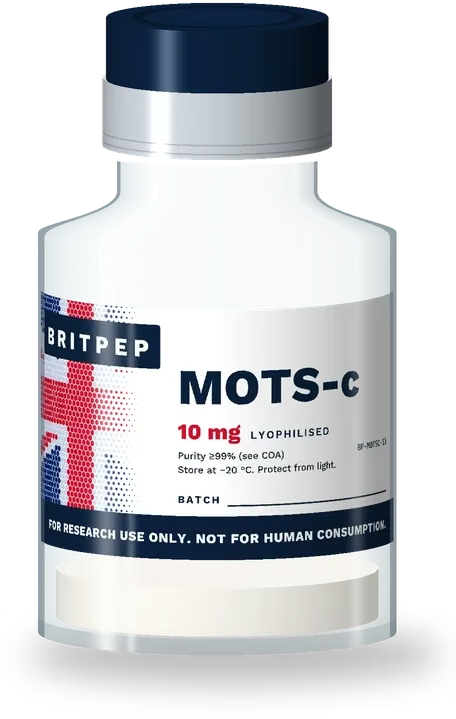
MOTS-c
MOTS-c (mitochondrial open reading frame of the 12S rRNA type-c) is a 16-residue peptide, MRWQEMGYIFYPRKLR, encoded within the mitochondrial 12S rRNA gene. It was described in 2015 by Lee, Cohen and colleagues [6].
Folate cycle and AMPK. In cells, MOTS-c was reported to inhibit the folate cycle and the linked de novo purine biosynthesis pathway, leading to accumulation of the purine intermediate AICAR and activation of AMP-activated protein kinase (AMPK) [6].
Nuclear translocation. A 2018 study reported that under metabolic stress MOTS-c moves to the nucleus in an AMPK-dependent manner and regulates nuclear genes, including antioxidant-response-element genes, interacting with NRF2 [8].
State of the field. MOTS-c research began in 2015 and much of it comes from the originating group and its collaborators. A 2023 review noted that no established method of clinical application has been developed [9]. No completed, published interventional trial was identified, and MOTS-c is not an approved medicine.
Further MOTS-c and SS-31 research
Exercise and physical capacity. A 2021 study reported that exercise increased endogenous MOTS-c levels in human skeletal muscle and circulation, and examined MOTS-c in young, middle-aged and old mice [13]. The human part of that work was observational, measuring the endogenous peptide.
Thermogenesis. A 2019 mouse study examined MOTS-c in cold adaptation and adipose thermogenic activation [14].
The wider family. MOTS-c belongs to a growing family of mitochondrial-derived peptides encoded by short open reading frames in mitochondrial DNA, reviewed in 2016 and 2022 [7][15]. Much remains unknown about how these peptides are exported from mitochondria and what their receptors or binding partners are.
Long-term SS-31 data. For SS-31, 168-week open-label extension results from the TAZPOWER study in Barth syndrome have been published [16]. Open-label extensions lack a concurrent control group, which limits the conclusions that can be drawn from them.
Related research tools: AICAR and NAD⁺
Because the MOTS-c literature runs through AMPK, two non-peptide reagents frequently appear alongside it.
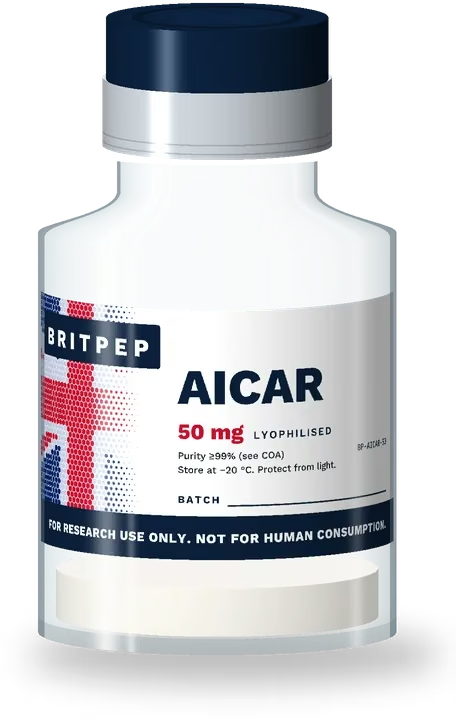
AICAR (5-aminoimidazole-4-carboxamide ribonucleoside) is a nucleoside that cells take up and phosphorylate to ZMP, an AMP analogue that activates AMPK; it has been used as a tool for activating AMPK in intact cells since the mid-1990s [10]. A 2021 systematic review highlights that AICAR also has important AMPK-independent effects, which complicate its use as a specific AMPK activator [11].
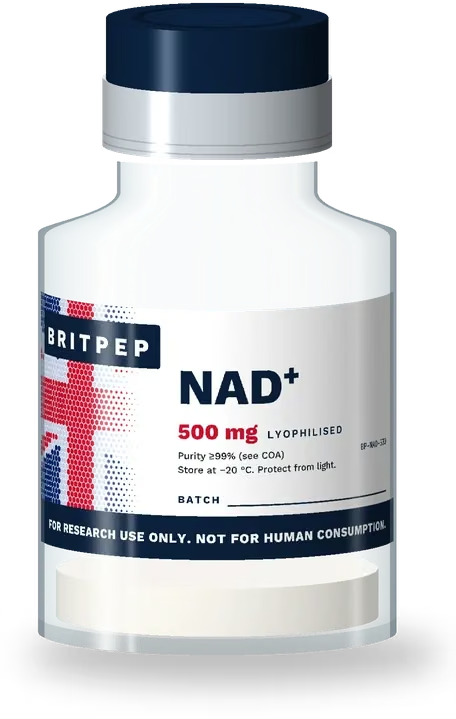
NAD⁺ is an essential redox cofactor and a substrate for sirtuins, PARPs and CD38, linking cellular NAD⁺ levels to signalling and metabolism [12].
Analytical and experimental considerations
SS-31 has a molecular formula of C32H49N9O5 and a free-base molecular weight of approximately 639.8 g/mol. As a small, strongly basic peptide it is normally supplied as a salt, so the lot-specific molecular weight on the certificate should be used for concentration calculations.
MOTS-c is larger, at 16 residues and approximately 2174.6 g/mol (C101H152N28O22S2). With several aromatic residues and a basic C-terminal region, it is well suited to reversed-phase HPLC and ESI mass spectrometry.
AMPK readouts. Because the MOTS-c and AICAR literatures both centre on AMPK, experiments in this area often measure downstream metabolic endpoints. In the original AICAR work in hepatocytes, AMPK activation was accompanied by inhibition of fatty-acid and sterol synthesis [10] – an example of pairing a kinase readout with a functional metabolic one.
Notes for experimental design
- SS-31 contains a non-natural residue (Dmt) and a D-amino acid; identity should be confirmed by mass spectrometry against the amidated tetrapeptide.
- MOTS-c contains two methionines and a tryptophan, residues susceptible to oxidation – store dry, cold and dark (see our storage guide).
- When using AICAR as an AMPK comparator, consider controls for its AMPK-independent effects [11].
Britpep supplies SS-31, MOTS-c, AICAR and NAD⁺ for laboratory research use only. They are not for human or veterinary use. See the mitochondrial and metabolic research collection.
References
- Szeto HH. Cell-permeable, mitochondrial-targeted, peptide antioxidants. AAPS J. 2006; 8:E277-83. doi:10.1007/BF02854898. PubMed 16796378
- Tung C, Varzideh F, Farroni E et al.. Elamipretide: A Review of Its Structure, Mechanism of Action, and Therapeutic Potential. Int J Mol Sci. 2025; 26. doi:10.3390/ijms26030944. PubMed 39940712
- Shirley M. Elamipretide: First Approval. Drugs. 2026; 86:377-383. doi:10.1007/s40265-025-02269-8. PubMed 41335372
- Birk AV, Liu S, Soong Y et al.. The mitochondrial-targeted compound SS-31 re-energizes ischemic mitochondria by interacting with cardiolipin. J Am Soc Nephrol. 2013; 24:1250-61. doi:10.1681/ASN.2012121216. PubMed 23813215
- Karaa A, Bertini E, Carelli V et al.. Efficacy and Safety of Elamipretide in Individuals With Primary Mitochondrial Myopathy: The MMPOWER-3 Randomized Clinical Trial. Neurology. 2023; 101:e238-e252. doi:10.1212/WNL.0000000000207402. PubMed 37268435
- Lee C, Zeng J, Drew BG et al.. The mitochondrial-derived peptide MOTS-c promotes metabolic homeostasis and reduces obesity and insulin resistance. Cell Metab. 2015; 21:443-54. doi:10.1016/j.cmet.2015.02.009. PubMed 25738459
- Lee C, Kim KH, Cohen P. MOTS-c: A novel mitochondrial-derived peptide regulating muscle and fat metabolism. Free Radic Biol Med. 2016; 100:182-187. doi:10.1016/j.freeradbiomed.2016.05.015. PubMed 27216708
- Kim KH, Son JM, Benayoun BA et al.. The Mitochondrial-Encoded Peptide MOTS-c Translocates to the Nucleus to Regulate Nuclear Gene Expression in Response to Metabolic Stress. Cell Metab. 2018; 28:516-524.e7. doi:10.1016/j.cmet.2018.06.008. PubMed 29983246
- Zheng Y, Wei Z, Wang T. MOTS-c: A promising mitochondrial-derived peptide for therapeutic exploitation. Front Endocrinol (Lausanne). 2023; 14:1120533. doi:10.3389/fendo.2023.1120533. PubMed 36761202
- Corton JM, Gillespie JG, Hawley SA et al.. 5-aminoimidazole-4-carboxamide ribonucleoside. A specific method for activating AMP-activated protein kinase in intact cells?. Eur J Biochem. 1995; 229:558-65. doi:10.1111/j.1432-1033.1995.tb20498.x. PubMed 7744080
- Višnjić D, Lalić H, Dembitz V et al.. AICAr, a Widely Used AMPK Activator with Important AMPK-Independent Effects: A Systematic Review. Cells. 2021; 10. doi:10.3390/cells10051095. PubMed 34064363
- Covarrubias AJ, Perrone R, Grozio A et al.. NAD(+) metabolism and its roles in cellular processes during ageing. Nat Rev Mol Cell Biol. 2021; 22:119-141. doi:10.1038/s41580-020-00313-x. PubMed 33353981
- Reynolds JC, Lai RW, Woodhead JST et al.. MOTS-c is an exercise-induced mitochondrial-encoded regulator of age-dependent physical decline and muscle homeostasis. Nat Commun. 2021; 12:470. doi:10.1038/s41467-020-20790-0. PubMed 33473109
- Lu H, Tang S, Xue C et al.. Mitochondrial-Derived Peptide MOTS-c Increases Adipose Thermogenic Activation to Promote Cold Adaptation. Int J Mol Sci. 2019; 20. doi:10.3390/ijms20102456. PubMed 31109005
- Mohtashami Z, Singh MK, Salimiaghdam N et al.. MOTS-c, the Most Recent Mitochondrial Derived Peptide in Human Aging and Age-Related Diseases. Int J Mol Sci. 2022; 23. doi:10.3390/ijms231911991. PubMed 36233287
- Thompson WR, Manuel R, Abbruscato A et al.. Long-term efficacy and safety of elamipretide in patients with Barth syndrome: 168-week open-label extension results of TAZPOWER. Genet Med. 2024; 26:101138. doi:10.1016/j.gim.2024.101138. PubMed 38602181
References were checked against PubMed and official UK sources at the time of writing. Summaries describe what each source reports; they are not claims about Britpep products.