
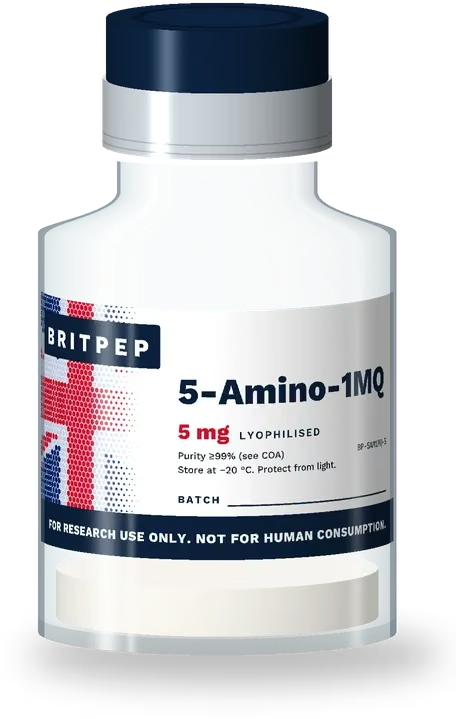
5-Amino-1MQ
Small-molecule methylquinolinium compound studied as an NNMT inhibitor in cell models.
Prepared to order · approx. 7 days + Royal Mail Tracked 24
SKU BP-5AM1MQ-5 · ≥99% (see COA) · Lyophilised powder
5-Amino-1MQ overview
5-Amino-1-methylquinolinium is a small molecule, not a peptide; the counter-ion should be confirmed on the COA. It is supplied as a solid for in-vitro research.
5-Amino-1MQ research background
Evidence status: Findings summarised here come from published cell-culture and animal research only; no controlled human studies were identified. They are not established effects in humans, have not been evaluated by the MHRA, and are provided for scientific context only. This product is supplied strictly for laboratory research and is not for human or veterinary use.
Established research
Peer-reviewed published findings, with referencesOverview & discovery history
- 5-Amino-1-methylquinolinium (5-amino-1MQ) is a small-molecule, membrane-permeable inhibitor of nicotinamide N-methyltransferase (NNMT), described by Neelakantan, Watowich and colleagues [1]. It is not a peptide.
Chemical identity
Identity values are confirmed per lot on the certificate of analysis. Salt/counter-ion form (e.g. acetate or TFA) is stated on the COA where applicable.
Mechanisms investigated
- NNMT inhibition: in adipocytes, this was reported to increase intracellular NAD⁺ and SAM and to reduce lipogenesis [1].
Research areas & model types
Human clinical research status
- No human trials were identified. It is not an approved medicine.
Safety observations reported in studies
- In the original mouse study, no observable adverse effects or changes in food intake were reported [1]. No human data exist.
Known limitations
- The evidence is preclinical only, largely from one group.
Storage & handling for laboratory use
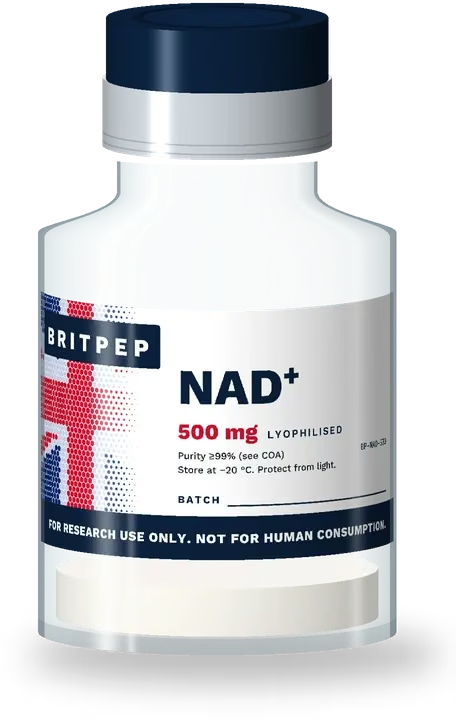
Store at −20 °C. Protect from light.
Store lyophilised material sealed at −20 °C or below, protected from light and moisture. Allow the vial to equilibrate to room temperature before opening to limit condensation.
- Allow the sealed vial to reach room temperature before opening to limit condensation.
- Any solutions should be prepared only for in-vitro laboratory work under your own validated protocol; aliquoting limits repeated freeze–thaw cycles.
- Handle with standard laboratory PPE in line with your risk assessment and the Safety Data Sheet (SDS). Britpep does not provide preparation or administration guidance.
Emerging & theoretical
Unconfirmed — hypotheses & ongoing researchThese are unconfirmed hypotheses and early-stage lines of enquiry, not established effects. Not evaluated by the MHRA. Not for human or veterinary use.
Hypotheses proposed by researchers
- Researchers have proposed NNMT as a target for metabolic disease, with increased NAD⁺ and SAM flux as a possible mechanism [1][2].
Open scientific questions
- What are its selectivity and off-target profile?
Preprints: none included (no relevant preprint could be verified). Anecdotal, user-reported or social-media material is deliberately excluded.
References
- Neelakantan H, Vance V, Wetzel MD et al.. Selective and membrane-permeable small molecule inhibitors of nicotinamide N-methyltransferase reverse high fat diet-induced obesity in mice. Biochem Pharmacol. 2018. PubMed 29155147 · doi:10.1016/j.bcp.2017.11.007
- Babula JJ, Bui D, Stevenson HL et al.. Nicotinamide N-methyltransferase inhibition mitigates obesity-related metabolic dysfunction. Diabetes Obes Metab. 2024. PubMed 39161060 · doi:10.1111/dom.15879
- Dimet-Wiley A, Wu Q, Wiley JT et al.. Reduced calorie diet combined with NNMT inhibition establishes a distinct microbiome in DIO mice. Sci Rep. 2022. PubMed 35013352 · doi:10.1038/s41598-021-03670-5
Every reference was checked against PubMed (NCBI) before publication. Summaries describe published research only and are not claims of any effect in humans or animals.
Certificates of analysis
[No batch COA published yet. The certificate for each lot will be listed here and in the COA checker before release.]
Related research compounds
Browse similar compounds: Mitochondrial & metabolic biochemistry research compounds or the full catalogue.