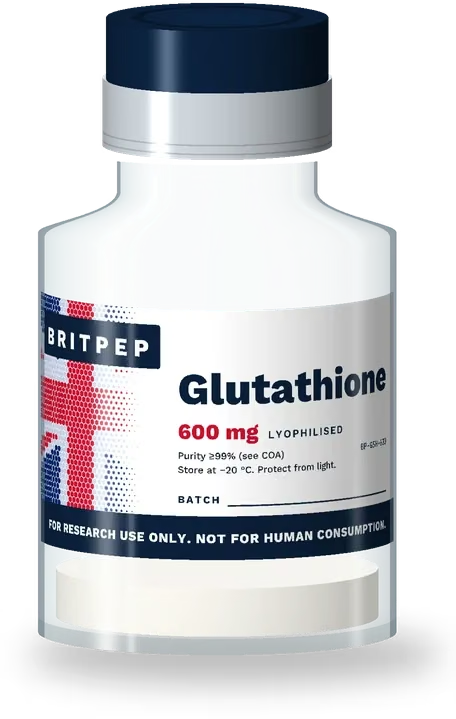
Glutathione (reduced)
The tripeptide γ-Glu-Cys-Gly (GSH), a standard reagent in redox biochemistry.
Prepared to order · approx. 7 days + Royal Mail Tracked 24
SKU BP-GSH-600 · ≥99% (see COA) · Lyophilised powder
Glutathione (reduced) overview
Reduced glutathione is the principal low-molecular-weight thiol in cells and a standard biochemical reagent. It is supplied as a lyophilised solid for in-vitro research.
Glutathione (reduced) research background
Evidence status: This compound is an established biochemical reagent; findings summarised here come from published biochemical, cell, animal and (where stated) human research. They are not established effects in humans, have not been evaluated by the MHRA, and are provided for scientific context only. This product is supplied strictly for laboratory research and is not for human or veterinary use.
Established research
Peer-reviewed published findings, with referencesOverview & discovery history
Chemical identity
Identity values are confirmed per lot on the certificate of analysis. Salt/counter-ion form (e.g. acetate or TFA) is stated on the COA where applicable.
Mechanisms investigated
Research areas & model types
Human clinical research status
Safety observations reported in studies
- The cited randomised trials reported safety within their study settings.
Known limitations
- Measuring glutathione status is methodologically complex.
Storage & handling for laboratory use
Store at −20 °C. Protect from light.
Store lyophilised material sealed at −20 °C or below, protected from light and moisture. Allow the vial to equilibrate to room temperature before opening to limit condensation.
- Allow the sealed vial to reach room temperature before opening to limit condensation.
- Any solutions should be prepared only for in-vitro laboratory work under your own validated protocol; aliquoting limits repeated freeze–thaw cycles.
- Handle with standard laboratory PPE in line with your risk assessment and the Safety Data Sheet (SDS). Britpep does not provide preparation or administration guidance.
Emerging & theoretical
Unconfirmed — hypotheses & ongoing researchThese are unconfirmed hypotheses and early-stage lines of enquiry, not established effects. Not evaluated by the MHRA. Not for human or veterinary use.
Hypotheses proposed by researchers
- No additional credible hypotheses beyond the established redox roles are summarised here.
Preprints: none included (no relevant preprint could be verified). Anecdotal, user-reported or social-media material is deliberately excluded.
References
- Meister A, Anderson ME. Glutathione. Annu Rev Biochem. 1983. PubMed 6137189 · doi:10.1146/annurev.bi.52.070183.003431
- Forman HJ, Zhang H, Rinna A. Glutathione: overview of its protective roles, measurement, and biosynthesis. Mol Aspects Med. 2009. PubMed 18796312 · doi:10.1016/j.mam.2008.08.006
- Richie JP Jr, Nichenametla S, Neidig W et al.. Randomized controlled trial of oral glutathione supplementation on body stores of glutathione. Eur J Nutr. 2015. PubMed 24791752 · doi:10.1007/s00394-014-0706-z
- Allen J, Bradley RD. Effects of oral glutathione supplementation on systemic oxidative stress biomarkers in human volunteers. J Altern Complement Med. 2011. PubMed 21875351 · doi:10.1089/acm.2010.0716
- Bozic M, Goss CH, Tirouvanziam RM et al.. Oral Glutathione and Growth in Cystic Fibrosis: A Multicenter, Randomized, Placebo-controlled, Double-blind Trial. J Pediatr Gastroenterol Nutr. 2020. PubMed 32960827 · doi:10.1097/MPG.0000000000002948
Every reference was checked against PubMed (NCBI) before publication. Summaries describe published research only and are not claims of any effect in humans or animals.
Certificates of analysis
[No batch COA published yet. The certificate for each lot will be listed here and in the COA checker before release.]