Discovery and chemistry
GHK – glycyl-L-histidyl-L-lysine – was identified in 1977 by Schlesinger, Pickart and Thaler as a growth-modulating tripeptide in human serum [1]. The tripeptide has a high affinity for copper(II) ions, and the structure of the glycyl-histidyl-lysine–copper(II) complex in solution was described in 1982 [2]. The copper complex, GHK-Cu, is the form most widely studied.
Research-grade GHK-Cu is supplied as a blue lyophilised solid. Because it is a metal complex and may be supplied in different salt forms, the stoichiometry and molecular weight should be read from the certificate of analysis rather than assumed. For a 1:1 complex the formula is C14H22CuN6O4, approximately 401.9 g/mol.
Fibroblasts and the extracellular matrix
The best-known in-vitro finding is from 1988, when GHK-Cu was reported to stimulate collagen synthesis in fibroblast cultures at picomolar to nanomolar concentrations, independently of any change in cell number [5]. Subsequent reviews by Pickart and colleagues describe GHK as a modulator of tissue remodelling, including effects on extracellular-matrix components [3][4].
This body of work is why GHK-Cu features in extracellular-matrix research and in cosmetic formulation science, where it is used as an ingredient [4].
Gene-expression analyses
A 2018 review analysed data from the Connectivity Map – a large database of gene-expression changes induced by small molecules in human cell lines – and suggested that GHK modulates the expression of a large number of human genes [6]. These analyses are hypothesis-generating: they identify associations in cell-line data rather than demonstrating a specific effect experimentally. Many broad claims made about GHK-Cu derive from this type of analysis rather than direct experiments, a limitation worth remembering when reading secondary sources.
Animal model findings – including mixed results
In mouse models of lipopolysaccharide-induced acute lung injury, GHK-Cu was reported to suppress NF-κB p65 and p38 MAPK signalling [7], and in a bleomycin model of pulmonary fibrosis, suppression of TGF-β1/Smad2/3 signalling was reported [8].
Other animal studies are less positive. In a rat ACL-reconstruction model, GHK-Cu produced transient differences at 6 weeks that were not present at 12 weeks [10]. In an irradiated rat wound model, topical copper tripeptide complex showed no difference from controls in flap ischaemia or vessel measures [9]. Taken together, the animal evidence is mixed and depends strongly on the model.
GHK-Cu is not an approved medicine in the UK, and no medicinal-product clinical trials leading to authorisation were identified.
Reading the GHK-Cu literature
Much of the review literature on GHK-Cu has been written by Loren Pickart, one of the scientists who first identified the tripeptide, and colleagues [3][4][6]. That continuity is valuable – it gives a single, detailed account of several decades of work – but, as with any field where reviews come largely from one group, it is worth reading the primary studies alongside them and giving particular weight to independent experiments.
The primary studies also differ widely in design: cell-culture work at picomolar to nanomolar concentrations [5], mouse lung-injury and fibrosis models [7][8], and rat surgical and wound models with mixed outcomes [9][10]. Findings in one system cannot be assumed to transfer to another.
AHK-Cu: a synthetic analogue
AHK-Cu (alanyl-histidyl-lysine copper(II)) replaces the N-terminal glycine with alanine. Very little peer-reviewed research is publicly available for it. One ex-vivo study using human hair follicles reported elongation of follicles and proliferation of dermal papilla cells, along with changes in the Bcl-2/Bax ratio and cleaved caspase-3 [11]. That finding has not been independently replicated, and no published safety studies were identified.
Related matrix peptides: Pal-KTTKS
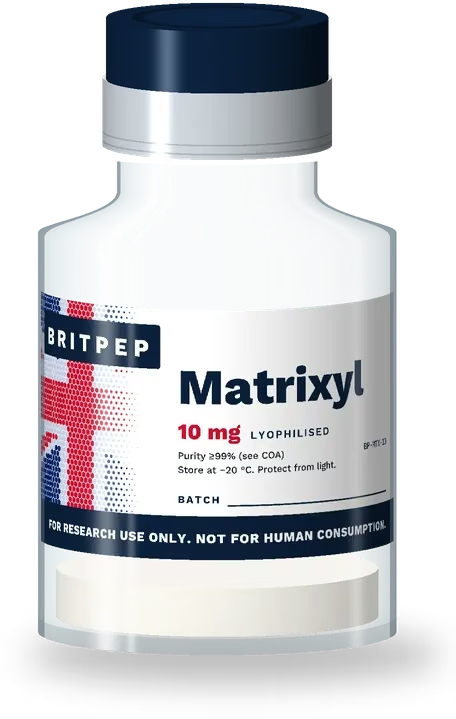
GHK-Cu is often discussed alongside other short peptides studied in extracellular-matrix research. One example is KTTKS (Lys-Thr-Thr-Lys-Ser), residues 212–216 of the type I procollagen C-terminal propeptide, which was identified in 1993 as the minimum sequence that stimulated collagen and fibronectin production in mesenchymal cells [12]. Its palmitoylated form, Pal-KTTKS (INCI palmitoyl pentapeptide-4, sold under the trade name Matrixyl), was developed to increase lipophilicity for formulation research [13].
An in-vitro permeation study comparing KTTKS and Pal-KTTKS found that palmitoylation increased retention in skin layers, but that neither peptide crossed full-thickness skin into the receptor fluid [13]. Like GHK-Cu, Pal-KTTKS is used as a cosmetic ingredient and is not a medicine.
Peptides of this kind – short fragments of matrix proteins with signalling activity – are sometimes called matrikines. For laboratories, the shared practical point is that small changes such as a palmitoyl group or a metal ion substantially change the physical chemistry of the material, so the exact form should always be confirmed from the certificate of analysis.
Practical notes
- Copper content. Free copper ions are themselves biologically active in cell culture. Experiments that compare GHK-Cu with GHK alone and with an equivalent copper salt are better able to attribute any effect to the complex.
- Identity. Mass spectrometry of metal complexes can show both the complexed and free peptide; the certificate should state which species was measured.
- Storage. Keep the lyophilised solid dry, cold and protected from light – see our storage guide.
Britpep supplies GHK-Cu, AHK-Cu and multi-component research blends containing GHK-Cu for laboratory research use only. They are not for human or veterinary use and are not cosmetics. See the extracellular-matrix research collection.
References
- Schlesinger DH, Pickart L, Thaler MM. Growth-modulating serum tripeptide is glycyl-histidyl-lysine. Experientia. 1977; 33:324-5. doi:10.1007/BF02002806. PubMed 858356
- Freedman JH, Pickart L, Weinstein B et al.. Structure of the Glycyl-L-histidyl-L-lysine--copper(II) complex in solution. Biochemistry. 1982; 21:4540-4. doi:10.1021/bi00262a004. PubMed 6291585
- Pickart L. The human tri-peptide GHK and tissue remodeling. J Biomater Sci Polym Ed. 2008; 19:969-88. doi:10.1163/156856208784909435. PubMed 18644225
- Pickart L, Vasquez-Soltero JM, Margolina A. GHK Peptide as a Natural Modulator of Multiple Cellular Pathways in Skin Regeneration. Biomed Res Int. 2015; 2015:648108. doi:10.1155/2015/648108. PubMed 26236730
- Maquart FX, Pickart L, Laurent M et al.. Stimulation of collagen synthesis in fibroblast cultures by the tripeptide-copper complex glycyl-L-histidyl-L-lysine-Cu2+. FEBS Lett. 1988; 238:343-6. doi:10.1016/0014-5793(88)80509-x. PubMed 3169264
- Pickart L, Margolina A. Regenerative and Protective Actions of the GHK-Cu Peptide in the Light of the New Gene Data. Int J Mol Sci. 2018; 19. doi:10.3390/ijms19071987. PubMed 29986520
- Park JR, Lee H, Kim SI et al.. The tri-peptide GHK-Cu complex ameliorates lipopolysaccharide-induced acute lung injury in mice. Oncotarget. 2016; 7:58405-58417. doi:10.18632/oncotarget.11168. PubMed 27517151
- Ma WH, Li M, Ma HF et al.. Protective effects of GHK-Cu in bleomycin-induced pulmonary fibrosis via anti-oxidative stress and anti-inflammation pathways. Life Sci. 2020; 241:117139. doi:10.1016/j.lfs.2019.117139. PubMed 31809714
- Parker NP, Ardeshirpour F, Schmechel SC et al.. Effects of topical copper tripeptide complex on wound healing in an irradiated rat model. Otolaryngol Head Neck Surg. 2013; 149:384-9. doi:10.1177/0194599813492644. PubMed 23744835
- Fu SC, Cheuk YC, Chiu WY et al.. Tripeptide-copper complex GHK-Cu (II) transiently improved healing outcome in a rat model of ACL reconstruction. J Orthop Res. 2015; 33:1024-33. doi:10.1002/jor.22831. PubMed 25731775
- Pyo HK, Yoo HG, Won CH et al.. The effect of tripeptide-copper complex on human hair growth in vitro. Arch Pharm Res. 2007; 30:834-9. doi:10.1007/BF02978833. PubMed 17703734
- Katayama K, Armendariz-Borunda J, Raghow R et al.. A pentapeptide from type I procollagen promotes extracellular matrix production. J Biol Chem. 1993; 268:9941-4. PubMed 8486721
- Choi YL, Park EJ, Kim E et al.. Dermal Stability and In Vitro Skin Permeation of Collagen Pentapeptides (KTTKS and palmitoyl-KTTKS). Biomol Ther (Seoul). 2014; 22:321-7. doi:10.4062/biomolther.2014.053. PubMed 25143811
References were checked against PubMed and official UK sources at the time of writing. Summaries describe what each source reports; they are not claims about Britpep products.