
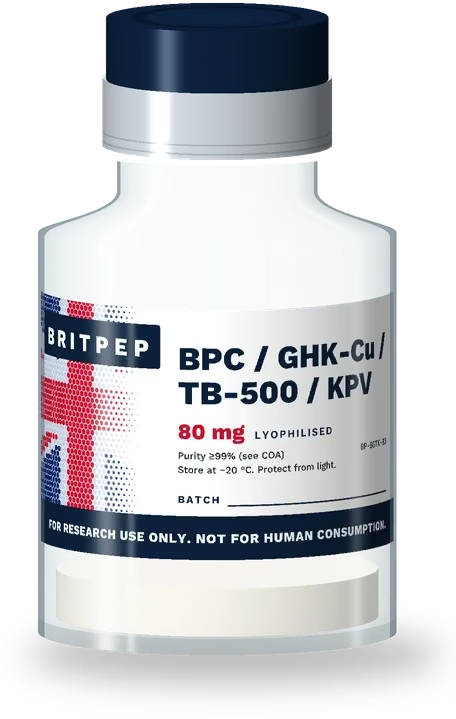
BPC-157 / GHK-Cu / TB-500 / KPV blend
Pre-mixed lyophilised combination of BPC-157, GHK-Cu, TB-500 and KPV (10 mg + 50 mg + 10 mg + 10 mg per vial).
Prepared to order · approx. 7 days + Royal Mail Tracked 24
SKU BP-BGTK-80 · ≥99% (see COA) · Lyophilised powder
Note: Components and ratio taken from the supplier list ("BPC 157 10mg+GHK-CU 50mg+TB500 10mg+KPV 10mg"). Confirm the per-component content from the batch COA.
BPC-157 / GHK-Cu / TB-500 / KPV blend overview
Each vial contains 10 mg, 50 mg, 10 mg, 10 mg of BPC-157, GHK-Cu, TB-500 and KPV respectively, co-lyophilised, per the supplier specification. See the individual component pages for data. Supplied for in-vitro laboratory research only.
BPC-157 / GHK-Cu / TB-500 / KPV blend research background
Evidence status: This combination has not been studied as a blend; findings summarised here relate to the individual components, much of it preclinical (cell or animal) or small-scale. They are not established effects in humans, have not been evaluated by the MHRA, and are provided for scientific context only. This product is supplied strictly for laboratory research and is not for human or veterinary use.
BPC-157
BPC-157 is a synthetic 15-amino-acid peptide whose sequence was described as a partial sequence of a protein ('body protection compound') isolated from gastric juice. Most of the published work comes from a single research group, and reviews have noted that independent replication is limited [1][2].
GHK-Cu
GHK (glycyl-L-histidyl-L-lysine) was identified in 1977 by Schlesinger, Pickart and Thaler as a growth-modulating tripeptide in human serum [3]. It has a high affinity for copper(II) and occurs naturally as the GHK-Cu complex [4].
TB-500 (Thymosin β4)
'TB-500' is a commercial name rather than a defined scientific compound. It is used both for synthetic full-length thymosin β4 (Tβ4, 43 amino acids) and for short fragments containing the actin-binding motif LKKTETQ (residues 17–23). For example, one registered clinical trial describes 'TB-500' as the thymosin β4 17–23 fragment (NCT07487363). The identity of this product must be confirmed from the batch COA.
Established research
Peer-reviewed published findings, with referencesOverview & discovery history
- This research blend combines 4 separately characterised compounds. The combination itself has not been studied in peer-reviewed research; the summaries below relate to each component individually. See each component's own product page for its full research background.
Chemical identity
Identity values are confirmed per lot on the certificate of analysis. Salt/counter-ion form (e.g. acetate or TFA) is stated on the COA where applicable.
Mechanisms investigated
- BPC-157: Nitric-oxide (NO) system: a series of rodent studies examined interactions between BPC-157 and NO-system modulators (L-NAME, L-arginine) [7].
- GHK-Cu: Collagen synthesis: in fibroblast culture, GHK-Cu was reported to stimulate collagen synthesis at picomolar to nanomolar concentrations, independent of cell number [8].
- TB-500 (Thymosin β4): G-actin sequestration: Tβ4 binds monomeric actin and regulates the pool available for polymerisation [9].
- KPV: PepT1 uptake: KPV is transported into intestinal epithelial and immune cells by the di/tripeptide transporter PepT1 [10].
Research areas & model types
| Research area | Model type | Summary |
|---|---|---|
| BPC-157 – Tendon and ligament injury models | Rodent; in vitro | Rat Achilles-tendon transection and tendon-fibroblast culture studies [15][16]; summarised in reviews of musculoskeletal soft-tissue research [1]. |
| BPC-157 – Angiogenesis and vascular models | In vitro; rodent | Chick chorioallantoic membrane assay, endothelial tube formation and rat hind-limb ischaemia [17]. |
| GHK-Cu – Fibroblast and extracellular-matrix biology | In vitro | [8][18] |
| GHK-Cu – Acute lung injury and fibrosis | Mouse | [19][20] |
| TB-500 (Thymosin β4) – Dermal wound models | Rodent; in vitro | Rat full-thickness wound model and keratinocyte migration assays [21]. |
| TB-500 (Thymosin β4) – Cardiac injury models | Mouse; in vitro | Coronary-artery ligation in mice and cardiomyocyte culture [22]. |
| KPV – Experimental colitis | Mouse | DSS and other murine colitis models [10][23]; colitis-associated cancer model [24]; nanoparticle delivery research [25]. |
| KPV – Airway epithelial inflammation | In vitro (human bronchial epithelial cells) | [26] |
Human clinical research status
- No studies of this combination were identified. Clinical-status notes for individual components are summarised below; they do not apply to the blend.
- BPC-157: No completed, published randomised controlled trial of BPC-157 was identified. A 2025 systematic review in orthopaedic sports medicine found only level IV–V evidence (case series and similar reports) in humans and reported that no clinical safety data were found [11].
- GHK-Cu: GHK-Cu is used as a cosmetic ingredient. It is not an approved medicine in the UK, and no medicinal-product clinical trials leading to authorisation were identified.
- TB-500 (Thymosin β4): Full-length Tβ4 (as investigational formulations) has been studied in Phase 2 trials in dry eye [12][13] and venous stasis ulcers [14]. Thymosin β4 is not an approved medicine in the UK, the US or the EU.
- KPV: No human clinical trials of KPV were identified. It is not an approved medicine.
Safety observations reported in studies
- No safety data exist for the combination. Interactions between components have not been studied.
Known limitations
- The combination has not been studied; whether the components interact chemically or biologically in solution is unknown.
Storage & handling for laboratory use
Store at −20 °C. Protect from light.
Store lyophilised material sealed at −20 °C or below, protected from light and moisture. Allow the vial to equilibrate to room temperature before opening to limit condensation.
- Allow the sealed vial to reach room temperature before opening to limit condensation.
- Any solutions should be prepared only for in-vitro laboratory work under your own validated protocol; aliquoting limits repeated freeze–thaw cycles.
- Handle with standard laboratory PPE in line with your risk assessment and the Safety Data Sheet (SDS). Britpep does not provide preparation or administration guidance.
Emerging & theoretical
Unconfirmed — hypotheses & ongoing researchThese are unconfirmed hypotheses and early-stage lines of enquiry, not established effects. Not evaluated by the MHRA. Not for human or veterinary use.
Hypotheses proposed by researchers
- BPC-157: Researchers have proposed that BPC-157 acts as a modulator of the NO system and of angiogenic signalling, which would link its varied reported effects in animal models [7][17].
- GHK-Cu: Researchers have proposed that GHK may broadly shift gene-expression patterns in the opposite direction to certain disease-associated expression signatures, based on Connectivity Map database analyses. This is an association-based hypothesis [27].
- TB-500 (Thymosin β4): Researchers have proposed that distinct Tβ4 activities sit in separate short sequences, which could allow fragment-based research tools [28].
- KPV: Researchers have proposed KPV and related α-MSH tripeptides as a class of anti-inflammatory agents for future development [6][5].
Registered clinical studies (ongoing or unpublished)
- NCT07437547 — BPC-157 (component, not the blend): Phase 2 randomised, placebo-controlled trial in acute grade II hamstring strain (sponsor: Hudson Biotech). Listed as recruiting.
- NCT07803250 — BPC-157 (component, not the blend): Phase 1 study in recovery after rotator-cuff repair surgery (sponsor: University of Arkansas). Listed as not yet recruiting.
- NCT07437586 — GHK-Cu (component, not the blend): Phase 2 vehicle-controlled split-wound study of a GHK-Cu gel on standardised punch-biopsy wounds (sponsor: Hudson Biotech). Listed as recruiting.
- NCT07487363 — TB-500 (Thymosin β4) (component, not the blend): Phase 1/2 dose-escalation study of 'TB-500 (thymosin β4 17–23 fragment)' in stable atherosclerotic cardiovascular disease (sponsor: Hudson Biotech). Listed as recruiting.
- NCT05555589 — TB-500 (Thymosin β4) (component, not the blend): Phase 3 SEER-2 trial of RGN-259 (thymosin β4) in neurotrophic keratopathy (sponsor: ReGenTree). Listed as recruiting.
- NCT07586865 — TB-500 (Thymosin β4) (component, not the blend): Phase IIc trial of recombinant human thymosin β4 (NL005) in acute myocardial infarction (sponsor: Beijing Northland Biotech). Listed as not yet recruiting.
Registry entries checked on ClinicalTrials.gov on 24 October 2026; status as listed by the sponsor. Registration does not imply results or efficacy.
Open scientific questions
- Whether the components are chemically compatible and stable when combined has not been reported.
Preprints: none included (no relevant preprint could be verified). Anecdotal, user-reported or social-media material is deliberately excluded.
References
- Gwyer D, Wragg NM, Wilson SL. Gastric pentadecapeptide body protection compound BPC 157 and its role in accelerating musculoskeletal soft tissue healing. Cell Tissue Res. 2019. PubMed 30915550 · doi:10.1007/s00441-019-03016-8
- McGuire FP, Martinez R, Lenz A et al.. Regeneration or Risk? A Narrative Review of BPC-157 for Musculoskeletal Healing. Curr Rev Musculoskelet Med. 2025. PubMed 40789979 · doi:10.1007/s12178-025-09990-7
- Schlesinger DH, Pickart L, Thaler MM. Growth-modulating serum tripeptide is glycyl-histidyl-lysine. Experientia. 1977. PubMed 858356 · doi:10.1007/BF02002806
- Freedman JH, Pickart L, Weinstein B et al.. Structure of the Glycyl-L-histidyl-L-lysine--copper(II) complex in solution. Biochemistry. 1982. PubMed 6291585 · doi:10.1021/bi00262a004
- Brzoska T, Luger TA, Maaser C et al.. Alpha-melanocyte-stimulating hormone and related tripeptides: biochemistry, antiinflammatory and protective effects in vitro and in vivo, and future perspectives for the treatment of immune-mediated inflammatory diseases. Endocr Rev. 2008. PubMed 18612139 · doi:10.1210/er.2007-0027
- Luger TA, Brzoska T. alpha-MSH related peptides: a new class of anti-inflammatory and immunomodulating drugs. Ann Rheum Dis. 2007. PubMed 17934097 · doi:10.1136/ard.2007.079780
- Sikiric P, Seiwerth S, Rucman R et al.. Stable gastric pentadecapeptide BPC 157-NO-system relation. Curr Pharm Des. 2014. PubMed 23755725 · doi:10.2174/13816128113190990411
- Maquart FX, Pickart L, Laurent M et al.. Stimulation of collagen synthesis in fibroblast cultures by the tripeptide-copper complex glycyl-L-histidyl-L-lysine-Cu2+. FEBS Lett. 1988. PubMed 3169264 · doi:10.1016/0014-5793(88)80509-x
- Cassimeris L, Safer D, Nachmias VT et al.. Thymosin beta 4 sequesters the majority of G-actin in resting human polymorphonuclear leukocytes. J Cell Biol. 1992. PubMed 1447300 · doi:10.1083/jcb.119.5.1261
- Dalmasso G, Charrier-Hisamuddin L, Nguyen HT et al.. PepT1-mediated tripeptide KPV uptake reduces intestinal inflammation. Gastroenterology. 2008. PubMed 18061177 · doi:10.1053/j.gastro.2007.10.026
- Vasireddi N, Hahamyan H, Salata MJ et al.. Emerging Use of BPC-157 in Orthopaedic Sports Medicine: A Systematic Review. HSS J. 2025. PubMed 40756949 · doi:10.1177/15563316251355551
- Sosne G, Dunn SP, Kim C. Thymosin β4 significantly improves signs and symptoms of severe dry eye in a phase 2 randomized trial. Cornea. 2015. PubMed 25826322 · doi:10.1097/ICO.0000000000000379
- Sosne G, Ousler GW. Thymosin beta 4 ophthalmic solution for dry eye: a randomized, placebo-controlled, Phase II clinical trial conducted using the controlled adverse environment (CAE™) model. Clin Ophthalmol. 2015. PubMed 26056426 · doi:10.2147/OPTH.S80954
- Guarnera G, DeRosa A, Camerini R. The effect of thymosin treatment of venous ulcers. Ann N Y Acad Sci. 2010. PubMed 20536470 · doi:10.1111/j.1749-6632.2010.05490.x
- Staresinic M, Sebecic B, Patrlj L et al.. Gastric pentadecapeptide BPC 157 accelerates healing of transected rat Achilles tendon and in vitro stimulates tendocytes growth. J Orthop Res. 2003. PubMed 14554208 · doi:10.1016/S0736-0266(03)00110-4
- Chang CH, Tsai WC, Lin MS et al.. The promoting effect of pentadecapeptide BPC 157 on tendon healing involves tendon outgrowth, cell survival, and cell migration. J Appl Physiol (1985). 2011. PubMed 21030672 · doi:10.1152/japplphysiol.00945.2010
- Hsieh MJ, Liu HT, Wang CN et al.. Therapeutic potential of pro-angiogenic BPC157 is associated with VEGFR2 activation and up-regulation. J Mol Med (Berl). 2017. PubMed 27847966 · doi:10.1007/s00109-016-1488-y
- Pickart L. The human tri-peptide GHK and tissue remodeling. J Biomater Sci Polym Ed. 2008. PubMed 18644225 · doi:10.1163/156856208784909435
- Park JR, Lee H, Kim SI et al.. The tri-peptide GHK-Cu complex ameliorates lipopolysaccharide-induced acute lung injury in mice. Oncotarget. 2016. PubMed 27517151 · doi:10.18632/oncotarget.11168
- Ma WH, Li M, Ma HF et al.. Protective effects of GHK-Cu in bleomycin-induced pulmonary fibrosis via anti-oxidative stress and anti-inflammation pathways. Life Sci. 2020. PubMed 31809714 · doi:10.1016/j.lfs.2019.117139
- Malinda KM, Sidhu GS, Mani H et al.. Thymosin beta4 accelerates wound healing. J Invest Dermatol. 1999. PubMed 10469335 · doi:10.1046/j.1523-1747.1999.00708.x
- Bock-Marquette I, Saxena A, White MD et al.. Thymosin beta4 activates integrin-linked kinase and promotes cardiac cell migration, survival and cardiac repair. Nature. 2004. PubMed 15565145 · doi:10.1038/nature03000
- Kannengiesser K, Maaser C, Heidemann J et al.. Melanocortin-derived tripeptide KPV has anti-inflammatory potential in murine models of inflammatory bowel disease. Inflamm Bowel Dis. 2008. PubMed 18092346 · doi:10.1002/ibd.20334
- Viennois E, Ingersoll SA, Ayyadurai S et al.. Critical role of PepT1 in promoting colitis-associated cancer and therapeutic benefits of the anti-inflammatory PepT1-mediated tripeptide KPV in a murine model. Cell Mol Gastroenterol Hepatol. 2016. PubMed 27458604 · doi:10.1016/j.jcmgh.2016.01.006
- Xiao B, Xu Z, Viennois E et al.. Orally Targeted Delivery of Tripeptide KPV via Hyaluronic Acid-Functionalized Nanoparticles Efficiently Alleviates Ulcerative Colitis. Mol Ther. 2017. PubMed 28143741 · doi:10.1016/j.ymthe.2016.11.020
- Land SC. Inhibition of cellular and systemic inflammation cues in human bronchial epithelial cells by melanocortin-related peptides: mechanism of KPV action and a role for MC3R agonists. Int J Physiol Pathophysiol Pharmacol. 2012. PubMed 22837805
- Pickart L, Margolina A. Regenerative and Protective Actions of the GHK-Cu Peptide in the Light of the New Gene Data. Int J Mol Sci. 2018. PubMed 29986520 · doi:10.3390/ijms19071987
- Sosne G, Qiu P, Goldstein AL et al.. Biological activities of thymosin beta4 defined by active sites in short peptide sequences. FASEB J. 2010. PubMed 20179146 · doi:10.1096/fj.09-142307
Every reference was checked against PubMed (NCBI) before publication. Summaries describe published research only and are not claims of any effect in humans or animals.
Certificates of analysis
[No batch COA published yet. The certificate for each lot will be listed here and in the COA checker before release.]
Related research compounds
BPC-157 / GHK-Cu / TB-500 blend
BPC-157
GHK-Cu
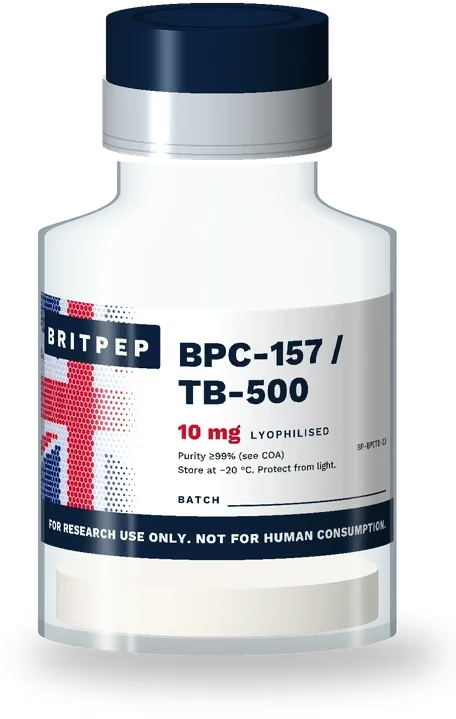
BPC-157 / TB-500 blend
Browse similar compounds: Extracellular-matrix & fibroblast research peptides, Research peptide blends or the full catalogue.