
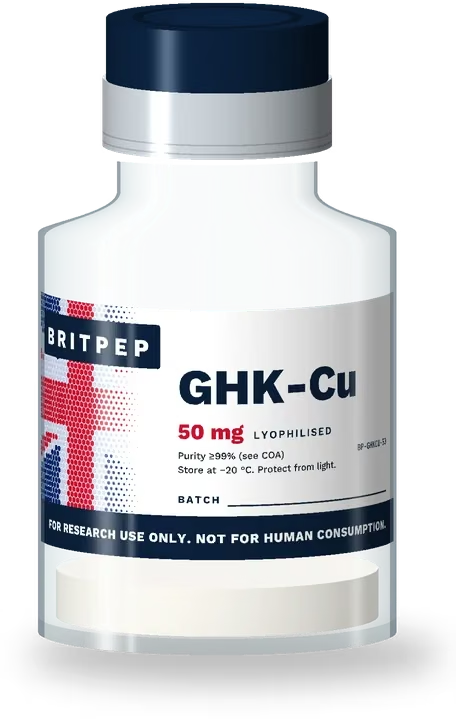
GHK-Cu
Copper(II) complex of the tripeptide Gly-His-Lys, used in fibroblast and extracellular-matrix research.
Prepared to order · approx. 7 days + Royal Mail Tracked 24
SKU BP-GHKCU-50 · ≥99% (see COA) · Lyophilised powder
GHK-Cu overview
GHK-Cu is the copper(II) complex of the naturally occurring tripeptide glycyl-L-histidyl-L-lysine. It is supplied as a lyophilised solid for in-vitro research.
GHK-Cu research background
Evidence status: Findings summarised here come mostly from cell-culture, animal and cosmetic-science research; GHK-Cu is used as a cosmetic ingredient, which is distinct from medicinal use. They are not established effects in humans, have not been evaluated by the MHRA, and are provided for scientific context only. This product is supplied strictly for laboratory research and is not for human or veterinary use.
Established research
Peer-reviewed published findings, with referencesOverview & discovery history
- GHK (glycyl-L-histidyl-L-lysine) was identified in 1977 by Schlesinger, Pickart and Thaler as a growth-modulating tripeptide in human serum [1]. It has a high affinity for copper(II) and occurs naturally as the GHK-Cu complex [2].
- GHK-Cu is widely studied in cosmetic science and in tissue-remodelling research [3][4].
Chemical identity
Identity values are confirmed per lot on the certificate of analysis. Salt/counter-ion form (e.g. acetate or TFA) is stated on the COA where applicable.
Mechanisms investigated
- Collagen synthesis: in fibroblast culture, GHK-Cu was reported to stimulate collagen synthesis at picomolar to nanomolar concentrations, independent of cell number [5].
- Gene-expression profiling: analyses of the Connectivity Map dataset suggest that GHK modulates the expression of many human genes [6].
- NF-κB and p38 MAPK: in macrophages and mouse lung-injury models, GHK-Cu was reported to suppress NF-κB p65 and p38 MAPK signalling [7]. TGF-β1/Smad2/3 suppression was reported in a bleomycin fibrosis model [8].
Research areas & model types
| Research area | Model type | Summary |
|---|---|---|
| Fibroblast and extracellular-matrix biology | In vitro | [5][3] |
| Acute lung injury and fibrosis | Mouse | [7][8] |
| Ligament graft models (ACL reconstruction) | Rat | Transient differences at 6 weeks but not at 12 weeks after ACL reconstruction [10]. |
| Irradiated wound model | Rat | No difference in flap ischaemia or vessel measures compared with controls [9]. |
| Cosmetic formulation science | Human (cosmetic studies); in vitro | Reviewed in [4]. |
Human clinical research status
- GHK-Cu is used as a cosmetic ingredient. It is not an approved medicine in the UK, and no medicinal-product clinical trials leading to authorisation were identified.
Safety observations reported in studies
- Animal studies cited here did not report notable toxicity, but formal safety evaluation outside cosmetic use is limited.
Known limitations
Storage & handling for laboratory use
Store at −20 °C. Protect from light.
Store lyophilised material sealed at −20 °C or below, protected from light and moisture. Allow the vial to equilibrate to room temperature before opening to limit condensation.
- Allow the sealed vial to reach room temperature before opening to limit condensation.
- Any solutions should be prepared only for in-vitro laboratory work under your own validated protocol; aliquoting limits repeated freeze–thaw cycles.
- Handle with standard laboratory PPE in line with your risk assessment and the Safety Data Sheet (SDS). Britpep does not provide preparation or administration guidance.
Emerging & theoretical
Unconfirmed — hypotheses & ongoing researchThese are unconfirmed hypotheses and early-stage lines of enquiry, not established effects. Not evaluated by the MHRA. Not for human or veterinary use.
Hypotheses proposed by researchers
- Researchers have proposed that GHK may broadly shift gene-expression patterns in the opposite direction to certain disease-associated expression signatures, based on Connectivity Map database analyses. This is an association-based hypothesis [6].
- It has been hypothesised that GHK is released from extracellular-matrix proteins (for example the α2(I) chain of collagen) at sites of injury [5].
Registered clinical studies (ongoing or unpublished)
- NCT07437586 — Phase 2 vehicle-controlled split-wound study of a GHK-Cu gel on standardised punch-biopsy wounds (sponsor: Hudson Biotech). Listed as recruiting.
Registry entries checked on ClinicalTrials.gov on 24 October 2026; status as listed by the sponsor. Registration does not imply results or efficacy.
Open scientific questions
- Which effects require copper, and which do not?
- How do gene-expression associations translate to measured outcomes?
Preprints: none included (no relevant preprint could be verified). Anecdotal, user-reported or social-media material is deliberately excluded.
References
- Schlesinger DH, Pickart L, Thaler MM. Growth-modulating serum tripeptide is glycyl-histidyl-lysine. Experientia. 1977. PubMed 858356 · doi:10.1007/BF02002806
- Freedman JH, Pickart L, Weinstein B et al.. Structure of the Glycyl-L-histidyl-L-lysine--copper(II) complex in solution. Biochemistry. 1982. PubMed 6291585 · doi:10.1021/bi00262a004
- Pickart L. The human tri-peptide GHK and tissue remodeling. J Biomater Sci Polym Ed. 2008. PubMed 18644225 · doi:10.1163/156856208784909435
- Pickart L, Vasquez-Soltero JM, Margolina A. GHK Peptide as a Natural Modulator of Multiple Cellular Pathways in Skin Regeneration. Biomed Res Int. 2015. PubMed 26236730 · doi:10.1155/2015/648108
- Maquart FX, Pickart L, Laurent M et al.. Stimulation of collagen synthesis in fibroblast cultures by the tripeptide-copper complex glycyl-L-histidyl-L-lysine-Cu2+. FEBS Lett. 1988. PubMed 3169264 · doi:10.1016/0014-5793(88)80509-x
- Pickart L, Margolina A. Regenerative and Protective Actions of the GHK-Cu Peptide in the Light of the New Gene Data. Int J Mol Sci. 2018. PubMed 29986520 · doi:10.3390/ijms19071987
- Park JR, Lee H, Kim SI et al.. The tri-peptide GHK-Cu complex ameliorates lipopolysaccharide-induced acute lung injury in mice. Oncotarget. 2016. PubMed 27517151 · doi:10.18632/oncotarget.11168
- Ma WH, Li M, Ma HF et al.. Protective effects of GHK-Cu in bleomycin-induced pulmonary fibrosis via anti-oxidative stress and anti-inflammation pathways. Life Sci. 2020. PubMed 31809714 · doi:10.1016/j.lfs.2019.117139
- Parker NP, Ardeshirpour F, Schmechel SC et al.. Effects of topical copper tripeptide complex on wound healing in an irradiated rat model. Otolaryngol Head Neck Surg. 2013. PubMed 23744835 · doi:10.1177/0194599813492644
- Fu SC, Cheuk YC, Chiu WY et al.. Tripeptide-copper complex GHK-Cu (II) transiently improved healing outcome in a rat model of ACL reconstruction. J Orthop Res. 2015. PubMed 25731775 · doi:10.1002/jor.22831
Every reference was checked against PubMed (NCBI) before publication. Summaries describe published research only and are not claims of any effect in humans or animals.
Certificates of analysis
| Lot | Size | Test date | HPLC purity | Report |
|---|---|---|---|---|
| BP-EX-24003 Example | 50 mg | 2026-03-21 | 99.6% (EXAMPLE) | Report for lot BP-EX-24003 → |
Related research compounds
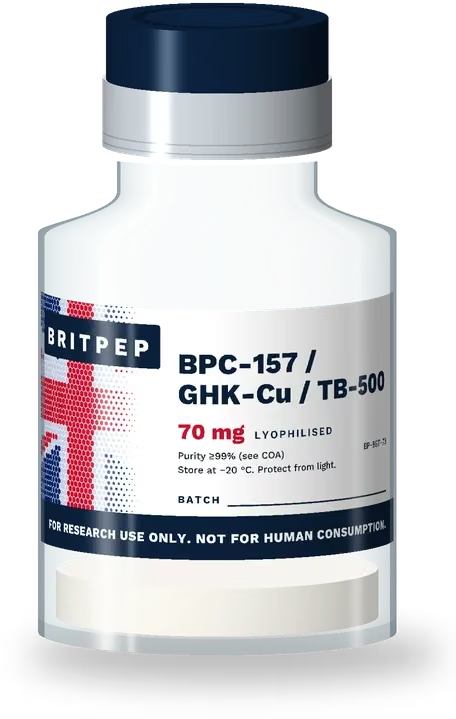
BPC-157 / GHK-Cu / TB-500 blend
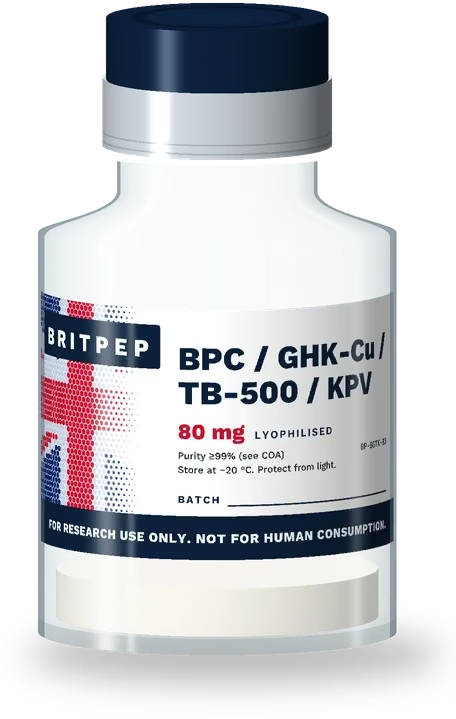
BPC-157 / GHK-Cu / TB-500 / KPV blend
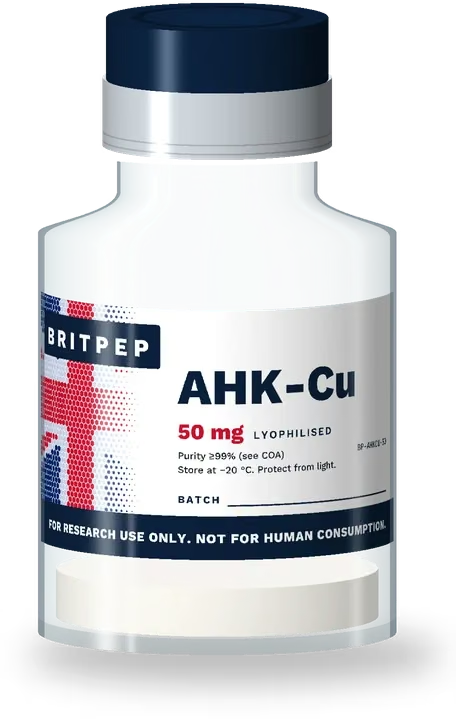
AHK-Cu
Matrixyl (Palmitoyl Pentapeptide-4)
Browse similar compounds: Extracellular-matrix & fibroblast research peptides or the full catalogue.