
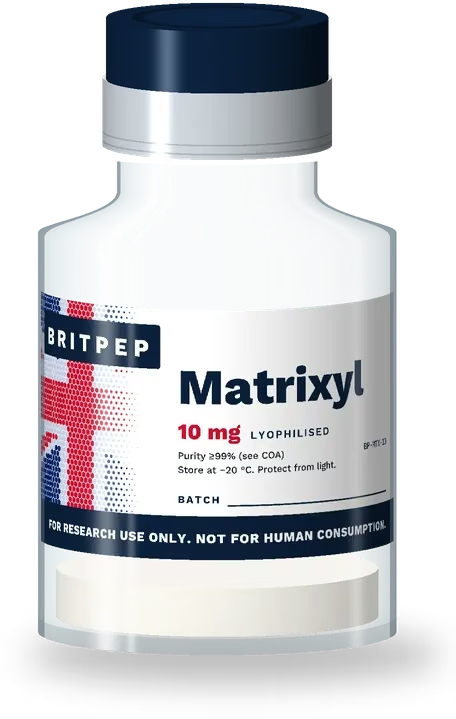
Matrixyl (Palmitoyl Pentapeptide-4)
Palmitoylated pentapeptide (Pal-KTTKS) used in cosmetic-science and extracellular-matrix research.
Prepared to order · approx. 7 days + Royal Mail Tracked 24
SKU BP-MTX-10 · ≥99% (see COA) · Lyophilised powder
Matrixyl (Palmitoyl Pentapeptide-4) overview
Matrixyl is a trade name for palmitoyl pentapeptide-4 (INCI), a lipidated fragment related to the C-terminal propeptide of type I procollagen. It is supplied as a lyophilised solid for in-vitro research.
Matrixyl (Palmitoyl Pentapeptide-4) research background
Evidence status: Findings summarised here come from cell-culture and cosmetic-science research; palmitoyl pentapeptide-4 is a cosmetic ingredient, which is distinct from medicinal use. They are not established effects in humans, have not been evaluated by the MHRA, and are provided for scientific context only. This product is supplied strictly for laboratory research and is not for human or veterinary use.
Established research
Peer-reviewed published findings, with referencesOverview & discovery history
- The pentapeptide KTTKS (Lys-Thr-Thr-Lys-Ser, residues 212–216 of the type I procollagen C-terminal propeptide) was identified in 1993 as the minimum sequence that stimulated collagen and fibronectin production in mesenchymal cells [1]. Palmitoylated KTTKS (Pal-KTTKS, INCI palmitoyl pentapeptide-4; trade name Matrixyl) was developed to increase lipophilicity for formulation research [2].
Chemical identity
Identity values are confirmed per lot on the certificate of analysis. Salt/counter-ion form (e.g. acetate or TFA) is stated on the COA where applicable.
Mechanisms investigated
Research areas & model types
Human clinical research status
- Pal-KTTKS is used as a cosmetic ingredient. It is not a medicine and no medicinal clinical development was identified.
Safety observations reported in studies
- No formal medicinal safety evaluation was identified; it is used as a cosmetic ingredient.
Known limitations
- In the permeation study, neither peptide crossed full-thickness skin into the receptor fluid [2].
- Much of the industry data is not peer-reviewed.
Storage & handling for laboratory use
Store at −20 °C. Protect from light.
Store lyophilised material sealed at −20 °C or below, protected from light and moisture. Allow the vial to equilibrate to room temperature before opening to limit condensation.
- Allow the sealed vial to reach room temperature before opening to limit condensation.
- Any solutions should be prepared only for in-vitro laboratory work under your own validated protocol; aliquoting limits repeated freeze–thaw cycles.
- Handle with standard laboratory PPE in line with your risk assessment and the Safety Data Sheet (SDS). Britpep does not provide preparation or administration guidance.
Emerging & theoretical
Unconfirmed — hypotheses & ongoing researchThese are unconfirmed hypotheses and early-stage lines of enquiry, not established effects. Not evaluated by the MHRA. Not for human or veterinary use.
Hypotheses proposed by researchers
- Researchers have proposed that KTTKS acts as a feedback signal released from procollagen to regulate matrix production [1].
Open scientific questions
- What receptor or pathway mediates the KTTKS response?
Preprints: none included (no relevant preprint could be verified). Anecdotal, user-reported or social-media material is deliberately excluded.
References
- Katayama K, Armendariz-Borunda J, Raghow R et al.. A pentapeptide from type I procollagen promotes extracellular matrix production. J Biol Chem. 1993. PubMed 8486721
- Choi YL, Park EJ, Kim E et al.. Dermal Stability and In Vitro Skin Permeation of Collagen Pentapeptides (KTTKS and palmitoyl-KTTKS). Biomol Ther (Seoul). 2014. PubMed 25143811 · doi:10.4062/biomolther.2014.053
- Vitali A, Paolicelli P, Bigi B et al.. Liposome Encapsulation of the Palmitoyl-KTTKS Peptide: Structural and Functional Characterization. Pharmaceutics. 2024. PubMed 38399273 · doi:10.3390/pharmaceutics16020219
- Chirita RI, Chaimbault P, Archambault JC et al.. Development of a LC-MS/MS method to monitor palmitoyl peptides content in anti-wrinkle cosmetics. Anal Chim Acta. 2009. PubMed 19393372 · doi:10.1016/j.aca.2009.03.015
Every reference was checked against PubMed (NCBI) before publication. Summaries describe published research only and are not claims of any effect in humans or animals.
Certificates of analysis
[No batch COA published yet. The certificate for each lot will be listed here and in the COA checker before release.]
Related research compounds
AHK-Cu
GHK-Cu
BPC-157 / GHK-Cu / TB-500 / KPV blend
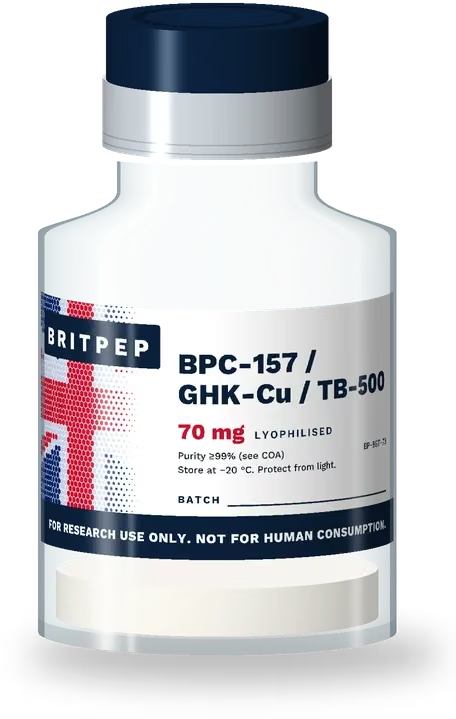
BPC-157 / GHK-Cu / TB-500 blend
Browse similar compounds: Extracellular-matrix & fibroblast research peptides or the full catalogue.