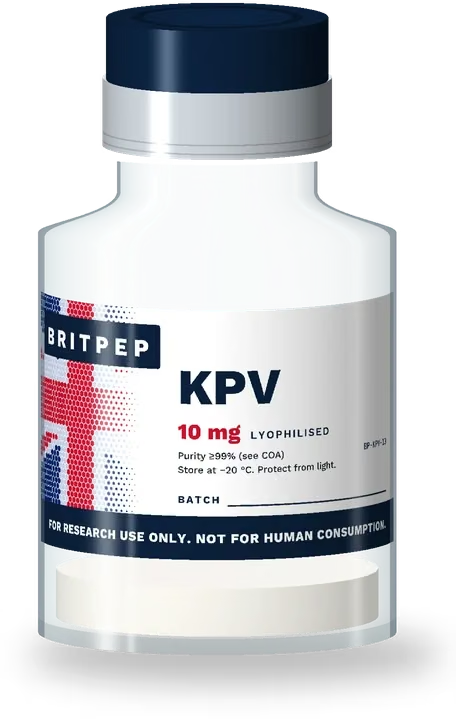
KPV
Tripeptide Lys-Pro-Val (C-terminal sequence of α-MSH) used in inflammatory-signalling research.
Prepared to order · approx. 7 days + Royal Mail Tracked 24
SKU BP-KPV-10 · ≥99% (see COA) · Lyophilised powder
KPV overview
KPV is the C-terminal tripeptide of α-melanocyte-stimulating hormone. It is supplied as a lyophilised solid for in-vitro research.
KPV research background
Evidence status: Findings summarised here come from published cell-culture and animal research only; no controlled human studies were identified. They are not established effects in humans, have not been evaluated by the MHRA, and are provided for scientific context only. This product is supplied strictly for laboratory research and is not for human or veterinary use.
Established research
Peer-reviewed published findings, with referencesOverview & discovery history
Chemical identity
Identity values are confirmed per lot on the certificate of analysis. Salt/counter-ion form (e.g. acetate or TFA) is stated on the COA where applicable.
Mechanisms investigated
- PepT1 uptake: KPV is transported into intestinal epithelial and immune cells by the di/tripeptide transporter PepT1 [3].
- NF-κB and MAPK signalling: KPV was reported to inhibit inflammatory signalling in epithelial cells. Effects in murine colitis appeared to be at least partly independent of MC1R [4][5].
Research areas & model types
Human clinical research status
- No human clinical trials of KPV were identified. It is not an approved medicine.
Safety observations reported in studies
- Formal toxicology data were not identified in the peer-reviewed literature.
Known limitations
- The evidence is preclinical only.
- Its receptor-level mechanism is not fully defined [4].
Storage & handling for laboratory use
Store at −20 °C. Protect from light.
Store lyophilised material sealed at −20 °C or below, protected from light and moisture. Allow the vial to equilibrate to room temperature before opening to limit condensation.
- Allow the sealed vial to reach room temperature before opening to limit condensation.
- Any solutions should be prepared only for in-vitro laboratory work under your own validated protocol; aliquoting limits repeated freeze–thaw cycles.
- Handle with standard laboratory PPE in line with your risk assessment and the Safety Data Sheet (SDS). Britpep does not provide preparation or administration guidance.
Emerging & theoretical
Unconfirmed — hypotheses & ongoing researchThese are unconfirmed hypotheses and early-stage lines of enquiry, not established effects. Not evaluated by the MHRA. Not for human or veterinary use.
Hypotheses proposed by researchers
- Researchers have proposed KPV and related α-MSH tripeptides as a class of anti-inflammatory agents for future development [2][1].
Open scientific questions
- What is its receptor-level mechanism beyond PepT1 uptake?
Preprints: none included (no relevant preprint could be verified). Anecdotal, user-reported or social-media material is deliberately excluded.
References
- Brzoska T, Luger TA, Maaser C et al.. Alpha-melanocyte-stimulating hormone and related tripeptides: biochemistry, antiinflammatory and protective effects in vitro and in vivo, and future perspectives for the treatment of immune-mediated inflammatory diseases. Endocr Rev. 2008. PubMed 18612139 · doi:10.1210/er.2007-0027
- Luger TA, Brzoska T. alpha-MSH related peptides: a new class of anti-inflammatory and immunomodulating drugs. Ann Rheum Dis. 2007. PubMed 17934097 · doi:10.1136/ard.2007.079780
- Dalmasso G, Charrier-Hisamuddin L, Nguyen HT et al.. PepT1-mediated tripeptide KPV uptake reduces intestinal inflammation. Gastroenterology. 2008. PubMed 18061177 · doi:10.1053/j.gastro.2007.10.026
- Kannengiesser K, Maaser C, Heidemann J et al.. Melanocortin-derived tripeptide KPV has anti-inflammatory potential in murine models of inflammatory bowel disease. Inflamm Bowel Dis. 2008. PubMed 18092346 · doi:10.1002/ibd.20334
- Land SC. Inhibition of cellular and systemic inflammation cues in human bronchial epithelial cells by melanocortin-related peptides: mechanism of KPV action and a role for MC3R agonists. Int J Physiol Pathophysiol Pharmacol. 2012. PubMed 22837805
- Viennois E, Ingersoll SA, Ayyadurai S et al.. Critical role of PepT1 in promoting colitis-associated cancer and therapeutic benefits of the anti-inflammatory PepT1-mediated tripeptide KPV in a murine model. Cell Mol Gastroenterol Hepatol. 2016. PubMed 27458604 · doi:10.1016/j.jcmgh.2016.01.006
- Xiao B, Xu Z, Viennois E et al.. Orally Targeted Delivery of Tripeptide KPV via Hyaluronic Acid-Functionalized Nanoparticles Efficiently Alleviates Ulcerative Colitis. Mol Ther. 2017. PubMed 28143741 · doi:10.1016/j.ymthe.2016.11.020
- Elliott RJ, Szabo M, Wagner MJ et al.. alpha-Melanocyte-stimulating hormone, MSH 11-13 KPV and adrenocorticotropic hormone signalling in human keratinocyte cells. J Invest Dermatol. 2004. PubMed 15102092 · doi:10.1111/j.0022-202X.2004.22404.x
Every reference was checked against PubMed (NCBI) before publication. Summaries describe published research only and are not claims of any effect in humans or animals.
Certificates of analysis
[No batch COA published yet. The certificate for each lot will be listed here and in the COA checker before release.]