
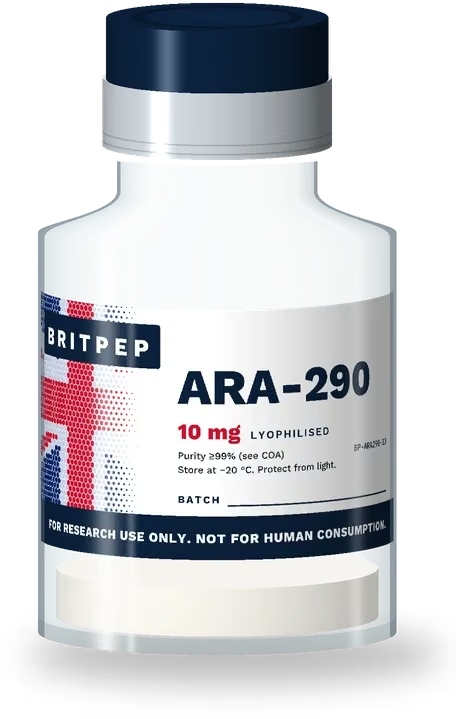
ARA-290 (Cibinetide)
11-residue peptide derived from erythropoietin helix B, used in EPOR/CD131 receptor-signalling research.
Prepared to order · approx. 7 days + Royal Mail Tracked 24
SKU BP-ARA290-10 · ≥99% (see COA) · Lyophilised powder
ARA-290 (Cibinetide) overview
ARA-290 (cibinetide) is a synthetic 11-amino-acid peptide modelled on the helix-B surface of erythropoietin. It is supplied as a lyophilised solid for in-vitro research. It is an investigational compound, not a licensed medicine; confirm its status with a solicitor.
ARA-290 (Cibinetide) research background
Evidence status: Findings summarised here come from preclinical research and small, early-phase human studies. They are not established effects in humans, have not been evaluated by the MHRA, and are provided for scientific context only. This product is supplied strictly for laboratory research and is not for human or veterinary use.
Established research
Peer-reviewed published findings, with referencesOverview & discovery history
- ARA-290 (cibinetide) is an 11-amino-acid peptide modelled on the aqueous face of helix B of erythropoietin (EPO). It was described in 2008 as tissue-protective but non-erythropoietic [1].
Chemical identity
Identity values are confirmed per lot on the certificate of analysis. Salt/counter-ion form (e.g. acetate or TFA) is stated on the COA where applicable.
Mechanisms investigated
- Tissue-protective receptor: helix-B-derived peptides are proposed to act via a receptor complex involving the β-common receptor (CD131), distinct from the classical erythropoietic EPO receptor; in macrophages its anti-inflammatory effects depended on CD131 and JAK2 [1][2].
- It was reported not to be erythropoietic in vitro or in vivo [1].
- Other pathways studied include TRPV1-related signalling in neuropathic pain models [3].
Research areas & model types
| Research area | Model type | Summary |
|---|---|---|
| Tissue-protection models | Rodent | Ischaemic stroke and renal ischaemia–reperfusion models [1]. |
| Experimental colitis | Mouse | [2] |
| Sarcoidosis-associated small-fibre neuropathy | Human (randomised Phase 2) | [4][5]; reviewed in [8] |
| Type 2 diabetes neuropathy | Human (Phase 2) | [6] |
| Diabetic macular oedema | Human (Phase 2) | [7] |
Human clinical research status
Safety observations reported in studies
- In the diabetic macular oedema study, a 12-week course was reported as safe [7]. No serious safety signals were reported in the published Phase 2 trials, which were small.
Known limitations
- The trials were small and short, with surrogate endpoints such as corneal nerve fibre measures [5].
Storage & handling for laboratory use
Store at −20 °C. Protect from light.
Store lyophilised material sealed at −20 °C or below, protected from light and moisture. Allow the vial to equilibrate to room temperature before opening to limit condensation.
- Allow the sealed vial to reach room temperature before opening to limit condensation.
- Any solutions should be prepared only for in-vitro laboratory work under your own validated protocol; aliquoting limits repeated freeze–thaw cycles.
- Handle with standard laboratory PPE in line with your risk assessment and the Safety Data Sheet (SDS). Britpep does not provide preparation or administration guidance.
Emerging & theoretical
Unconfirmed — hypotheses & ongoing researchThese are unconfirmed hypotheses and early-stage lines of enquiry, not established effects. Not evaluated by the MHRA. Not for human or veterinary use.
Hypotheses proposed by researchers
- Researchers have proposed corneal nerve fibre abundance as a surrogate endpoint for disease-modifying neuropathy research [5].
Open scientific questions
- What is the structural basis of the EPOR/CD131 interaction?
Preprints: none included (no relevant preprint could be verified). Anecdotal, user-reported or social-media material is deliberately excluded.
References
- Brines M, Patel NS, Villa P et al.. Nonerythropoietic, tissue-protective peptides derived from the tertiary structure of erythropoietin. Proc Natl Acad Sci U S A. 2008. PubMed 18676614 · doi:10.1073/pnas.0805594105
- Nairz M, Haschka D, Dichtl S et al.. Cibinetide dampens innate immune cell functions thus ameliorating the course of experimental colitis. Sci Rep. 2017. PubMed 29026145 · doi:10.1038/s41598-017-13046-3
- Zhang W, Yu G, Zhang M. ARA 290 relieves pathophysiological pain by targeting TRPV1 channel: Integration between immune system and nociception. Peptides. 2016. PubMed 26774587 · doi:10.1016/j.peptides.2016.01.003
- Dahan A, Dunne A, Swartjes M et al.. ARA 290 improves symptoms in patients with sarcoidosis-associated small nerve fiber loss and increases corneal nerve fiber density. Mol Med. 2013. PubMed 24136731 · doi:10.2119/molmed.2013.00122
- Culver DA, Dahan A, Bajorunas D et al.. Cibinetide Improves Corneal Nerve Fiber Abundance in Patients With Sarcoidosis-Associated Small Nerve Fiber Loss and Neuropathic Pain. Invest Ophthalmol Vis Sci. 2017. PubMed 28475703 · doi:10.1167/iovs.16-21291
- Brines M, Dunne AN, van Velzen M et al.. ARA 290, a nonerythropoietic peptide engineered from erythropoietin, improves metabolic control and neuropathic symptoms in patients with type 2 diabetes. Mol Med. 2015. PubMed 25387363 · doi:10.2119/molmed.2014.00215
- Lois N, Gardner E, McFarland M et al.. A Phase 2 Clinical Trial on the Use of Cibinetide for the Treatment of Diabetic Macular Edema. J Clin Med. 2020. PubMed 32674280 · doi:10.3390/jcm9072225
- van Velzen M, Heij L, Niesters M et al.. ARA 290 for treatment of small fiber neuropathy in sarcoidosis. Expert Opin Investig Drugs. 2014. PubMed 24555851 · doi:10.1517/13543784.2014.892072
Every reference was checked against PubMed (NCBI) before publication. Summaries describe published research only and are not claims of any effect in humans or animals.
Certificates of analysis
[No batch COA published yet. The certificate for each lot will be listed here and in the COA checker before release.]
Related research compounds
Browse similar compounds: Cell-signalling research peptides or the full catalogue.