
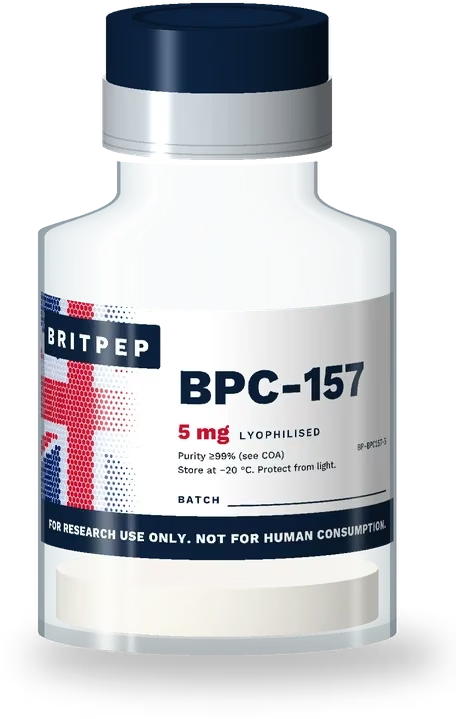
BPC-157
Synthetic 15-residue peptide corresponding to a partial sequence of a gastric protein, used in cell-signalling research.
Prepared to order · approx. 7 days + Royal Mail Tracked 24
SKU BP-BPC157-5 · ≥99% (see COA) · Lyophilised powder
BPC-157 overview
BPC-157 (Body Protection Compound-157) is a synthetic pentadecapeptide whose sequence derives from a protein isolated from gastric juice. It is supplied as a lyophilised solid for in-vitro laboratory research.
BPC-157 research background
Evidence status: Findings summarised here come from published research, much of it preclinical (cell or animal), with only very small or uncontrolled human reports. They are not established effects in humans, have not been evaluated by the MHRA, and are provided for scientific context only. This product is supplied strictly for laboratory research and is not for human or veterinary use.
Established research
Peer-reviewed published findings, with referencesOverview & discovery history
- BPC-157 is a synthetic 15-amino-acid peptide whose sequence was described as a partial sequence of a protein ('body protection compound') isolated from gastric juice. Most of the published work comes from a single research group, and reviews have noted that independent replication is limited [1][2].
- Studies have been published mainly in rodent models of gastrointestinal, musculoskeletal and vascular injury, together with a smaller number of cell-culture studies [3][4].
Chemical identity
Identity values are confirmed per lot on the certificate of analysis. Salt/counter-ion form (e.g. acetate or TFA) is stated on the COA where applicable.
Mechanisms investigated
- Nitric-oxide (NO) system: a series of rodent studies examined interactions between BPC-157 and NO-system modulators (L-NAME, L-arginine) [5].
- VEGFR2–Akt–eNOS signalling: in endothelial cell culture and a rat hind-limb ischaemia model, BPC-157 was reported to up-regulate VEGFR2 expression and promote VEGFR2 internalisation [6].
- FAK–paxillin and F-actin: in cultured tendon fibroblasts, BPC-157 was reported to increase FAK and paxillin phosphorylation and F-actin formation [7].
- Tendocyte growth in vitro: one study reported that BPC-157 opposed the growth-inhibiting effect of 4-hydroxynonenal in cultured tendocytes [8].
- A single, definitive molecular target or receptor has not been established.
Research areas & model types
| Research area | Model type | Summary |
|---|---|---|
| Tendon and ligament injury models | Rodent; in vitro | Rat Achilles-tendon transection and tendon-fibroblast culture studies [8][7]; summarised in reviews of musculoskeletal soft-tissue research [1]. |
| Angiogenesis and vascular models | In vitro; rodent | Chick chorioallantoic membrane assay, endothelial tube formation and rat hind-limb ischaemia [6]. |
| Wound models (review) | Rodent | Reviewed in [10]. |
| Central nervous system models | Rodent | Reviewed in [11], largely from the originating group. |
| Gastrointestinal and NO-system models | Rodent | Reviewed in [5][3]. |
Human clinical research status
- No completed, published randomised controlled trial of BPC-157 was identified. A 2025 systematic review in orthopaedic sports medicine found only level IV–V evidence (case series and similar reports) in humans and reported that no clinical safety data were found [9].
- BPC-157 is not an approved medicine in the UK, the US or the EU. A 2025 literature and patent review notes that it has not been approved by the FDA or other regulators because of insufficient clinical study [4].
Safety observations reported in studies
- Reviews report that preclinical studies in animals have described few adverse findings, but formal toxicology and human safety data are limited [9][2].
- A 2025 narrative review emphasises that products from non-regulated sources carry contamination and quality risks, and that human data are minimal [2].
Known limitations
Storage & handling for laboratory use
Store at −20 °C. Protect from light.
Store lyophilised material sealed at −20 °C or below, protected from light and moisture. Allow the vial to equilibrate to room temperature before opening to limit condensation.
- Allow the sealed vial to reach room temperature before opening to limit condensation.
- Any solutions should be prepared only for in-vitro laboratory work under your own validated protocol; aliquoting limits repeated freeze–thaw cycles.
- Handle with standard laboratory PPE in line with your risk assessment and the Safety Data Sheet (SDS). Britpep does not provide preparation or administration guidance.
Emerging & theoretical
Unconfirmed — hypotheses & ongoing researchThese are unconfirmed hypotheses and early-stage lines of enquiry, not established effects. Not evaluated by the MHRA. Not for human or veterinary use.
Hypotheses proposed by researchers
- Researchers have proposed that BPC-157 acts as a modulator of the NO system and of angiogenic signalling, which would link its varied reported effects in animal models [5][6].
- Review authors have hypothesised a role in hypovascular soft tissues such as tendon and ligament, while stating that this requires well-designed clinical trials [1][2].
Registered clinical studies (ongoing or unpublished)
- NCT07437547 — Phase 2 randomised, placebo-controlled trial in acute grade II hamstring strain (sponsor: Hudson Biotech). Listed as recruiting.
- NCT07803250 — Phase 1 study in recovery after rotator-cuff repair surgery (sponsor: University of Arkansas). Listed as not yet recruiting.
Registry entries checked on ClinicalTrials.gov on 24 October 2026; status as listed by the sponsor. Registration does not imply results or efficacy.
Open scientific questions
- What is the molecular target or receptor?
- Do the findings replicate in laboratories independent of the originating group?
- What are the pharmacokinetics and stability in biological matrices?
Preprints: none included (no relevant preprint could be verified). Anecdotal, user-reported or social-media material is deliberately excluded.
References
- Gwyer D, Wragg NM, Wilson SL. Gastric pentadecapeptide body protection compound BPC 157 and its role in accelerating musculoskeletal soft tissue healing. Cell Tissue Res. 2019. PubMed 30915550 · doi:10.1007/s00441-019-03016-8
- McGuire FP, Martinez R, Lenz A et al.. Regeneration or Risk? A Narrative Review of BPC-157 for Musculoskeletal Healing. Curr Rev Musculoskelet Med. 2025. PubMed 40789979 · doi:10.1007/s12178-025-09990-7
- Seiwerth S, Rucman R, Turkovic B et al.. BPC 157 and Standard Angiogenic Growth Factors. Gastrointestinal Tract Healing, Lessons from Tendon, Ligament, Muscle and Bone Healing. Curr Pharm Des. 2018. PubMed 29998800 · doi:10.2174/1381612824666180712110447
- Józwiak M, Bauer M, Kamysz W et al.. Multifunctionality and Possible Medical Application of the BPC 157 Peptide-Literature and Patent Review. Pharmaceuticals (Basel). 2025. PubMed 40005999 · doi:10.3390/ph18020185
- Sikiric P, Seiwerth S, Rucman R et al.. Stable gastric pentadecapeptide BPC 157-NO-system relation. Curr Pharm Des. 2014. PubMed 23755725 · doi:10.2174/13816128113190990411
- Hsieh MJ, Liu HT, Wang CN et al.. Therapeutic potential of pro-angiogenic BPC157 is associated with VEGFR2 activation and up-regulation. J Mol Med (Berl). 2017. PubMed 27847966 · doi:10.1007/s00109-016-1488-y
- Chang CH, Tsai WC, Lin MS et al.. The promoting effect of pentadecapeptide BPC 157 on tendon healing involves tendon outgrowth, cell survival, and cell migration. J Appl Physiol (1985). 2011. PubMed 21030672 · doi:10.1152/japplphysiol.00945.2010
- Staresinic M, Sebecic B, Patrlj L et al.. Gastric pentadecapeptide BPC 157 accelerates healing of transected rat Achilles tendon and in vitro stimulates tendocytes growth. J Orthop Res. 2003. PubMed 14554208 · doi:10.1016/S0736-0266(03)00110-4
- Vasireddi N, Hahamyan H, Salata MJ et al.. Emerging Use of BPC-157 in Orthopaedic Sports Medicine: A Systematic Review. HSS J. 2025. PubMed 40756949 · doi:10.1177/15563316251355551
- Seiwerth S, Milavic M, Vukojevic J et al.. Stable Gastric Pentadecapeptide BPC 157 and Wound Healing. Front Pharmacol. 2021. PubMed 34267654 · doi:10.3389/fphar.2021.627533
- Vukojevic J, Milavić M, Perović D et al.. Pentadecapeptide BPC 157 and the central nervous system. Neural Regen Res. 2022. PubMed 34380875 · doi:10.4103/1673-5374.320969
Every reference was checked against PubMed (NCBI) before publication. Summaries describe published research only and are not claims of any effect in humans or animals.
Certificates of analysis
| Lot | Size | Test date | HPLC purity | Report |
|---|---|---|---|---|
| BP-EX-24001 Example | 5 mg | 2026-01-14 | 99.4% (EXAMPLE) | Report for lot BP-EX-24001 → |
| BP-EX-24002 Example | 5 mg | 2026-02-03 | 99.2% (EXAMPLE) | Report for lot BP-EX-24002 → |
Related research compounds
BPC-157 / TB-500 blend
BPC-157 / GHK-Cu / TB-500 blend
BPC-157 / GHK-Cu / TB-500 / KPV blend
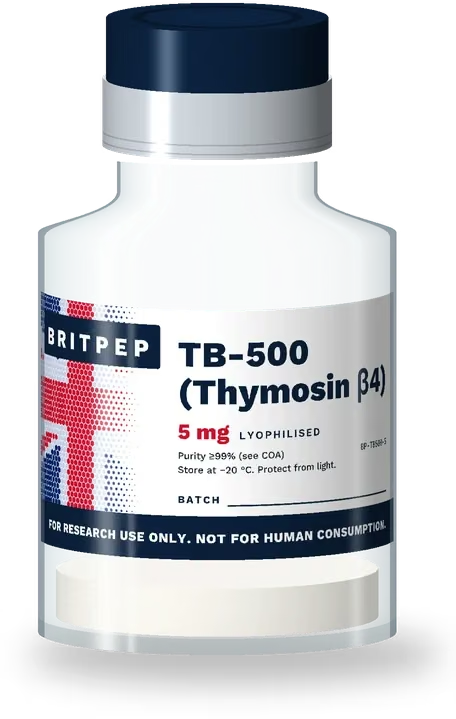
TB-500 (Thymosin β4)
Browse similar compounds: Cell-signalling research peptides or the full catalogue.