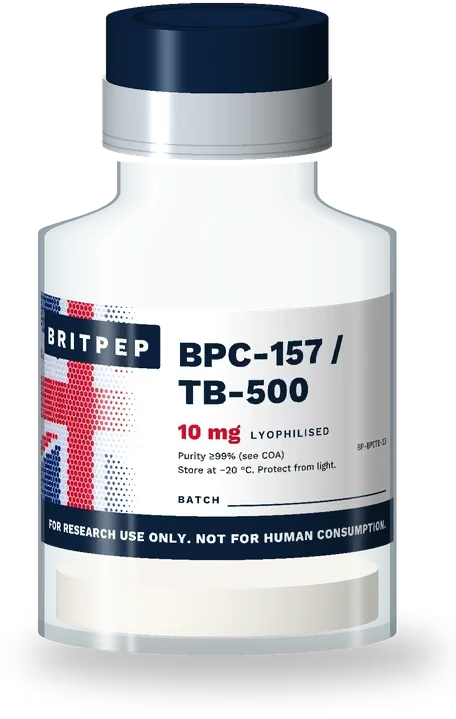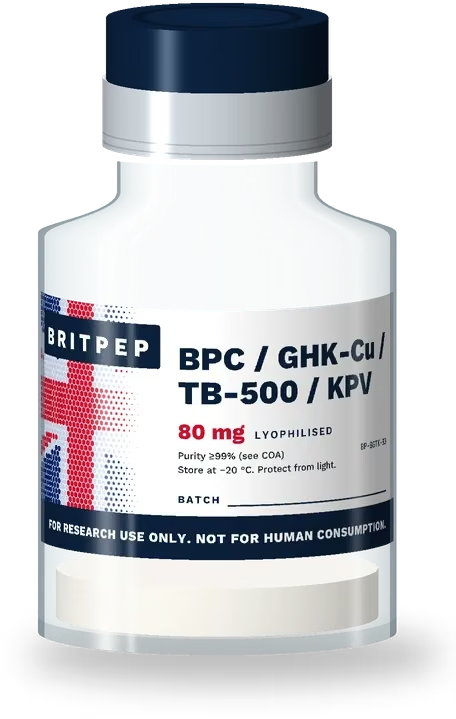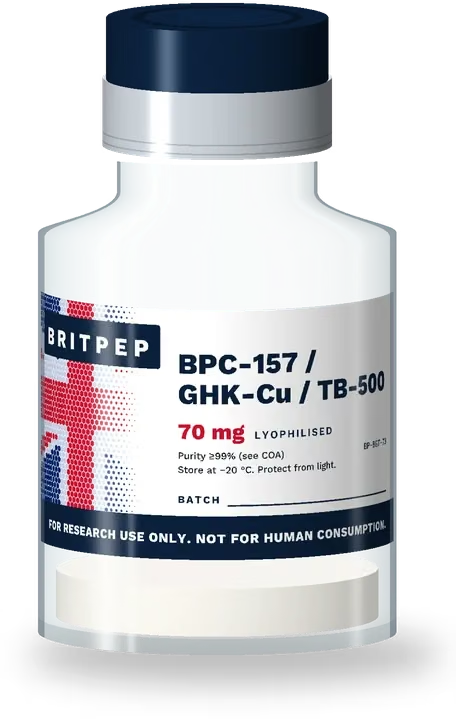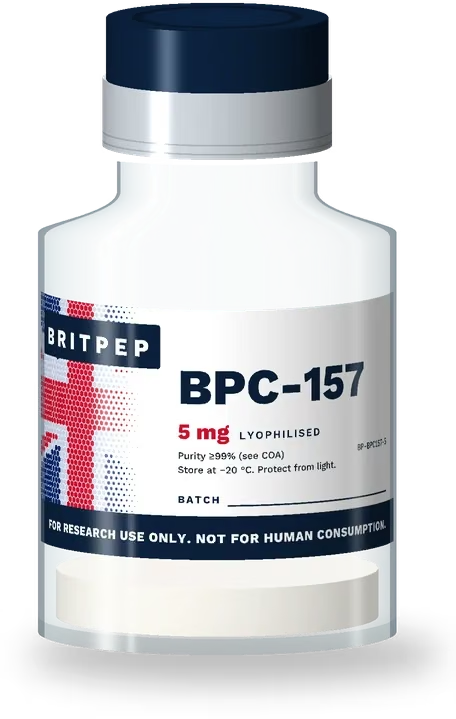
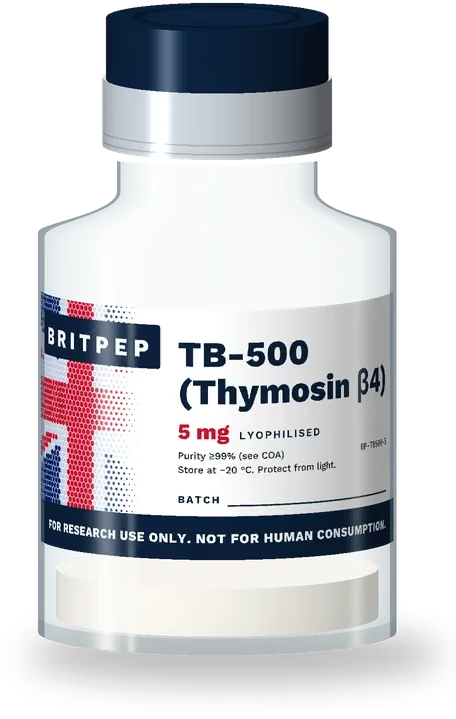
TB-500 (Thymosin β4)
Synthetic thymosin β4-related peptide used in actin-cytoskeleton research.
Prepared to order · approx. 7 days + Royal Mail Tracked 24
SKU BP-TB500-5 · ≥99% (see COA) · Lyophilised powder
Note: CONFIRM WITH SUPPLIER: full-length thymosin β4 (43 aa) or fragment (e.g. Ac-LKKTETQ). Update all fields to match the COA.
TB-500 (Thymosin β4) overview
Supplied as 'TB500 (Thymosin β4 acetate)' (the supplier sheet reads 'Thymosin B5', assumed to be a typo for β4). The name 'TB-500' is used in the trade for both full-length thymosin β4 and shorter synthetic fragments. The supplier must confirm which is supplied before launch; the data below are for full-length thymosin β4.
TB-500 (Thymosin β4) research background
Evidence status: Findings summarised here relate mainly to thymosin β4 (the parent protein) and come from preclinical research and small early-phase human studies; 'TB-500' itself is a trade name whose exact identity varies between suppliers. They are not established effects in humans, have not been evaluated by the MHRA, and are provided for scientific context only. This product is supplied strictly for laboratory research and is not for human or veterinary use.
Established research
Peer-reviewed published findings, with referencesOverview & discovery history
- 'TB-500' is a commercial name rather than a defined scientific compound. It is used both for synthetic full-length thymosin β4 (Tβ4, 43 amino acids) and for short fragments containing the actin-binding motif LKKTETQ (residues 17–23). For example, one registered clinical trial describes 'TB-500' as the thymosin β4 17–23 fragment (NCT07487363). The identity of this product must be confirmed from the batch COA.
- Thymosin β4 was first characterised as the main G-actin-sequestering peptide in many cell types [1]. Later work linked it to cell migration, angiogenesis and tissue repair in experimental models [2][3].
Chemical identity
Identity values are confirmed per lot on the certificate of analysis. Salt/counter-ion form (e.g. acetate or TFA) is stated on the COA where applicable.
Mechanisms investigated
- G-actin sequestration: Tβ4 binds monomeric actin and regulates the pool available for polymerisation [1].
- Active sites in short sequences: the LKKTETQ region (aa 17–23) has been linked to actin binding, cell migration and angiogenesis in vitro, and the N-terminal Ac-SDKP tetrapeptide to other activities [4].
- ILK/PINCH/Akt: in mouse cardiac models, Tβ4 formed a complex with PINCH and integrin-linked kinase, which activated Akt [5].
- Keratinocyte and endothelial migration was reported in Boyden-chamber assays [6].
Research areas & model types
| Research area | Model type | Summary |
|---|---|---|
| Dermal wound models | Rodent; in vitro | Rat full-thickness wound model and keratinocyte migration assays [6]. |
| Cardiac injury models | Mouse; in vitro | Coronary-artery ligation in mice and cardiomyocyte culture [5]. |
| Corneal and ocular surface | Human (Phase 2); preclinical | Development of an investigational Tβ4 formulation (RGN-259) for ocular surface disorders [10][7][8]. |
| Dermal ulcers | Human (Phase 2) | A European Phase 2 placebo-controlled dose-escalation study in venous stasis ulcers [11][9]. |
Human clinical research status
Safety observations reported in studies
Known limitations
- Results for full-length Tβ4 cannot be assumed to apply to short fragments, or the reverse [4].
- The clinical trials were small, and the formulations studied were specific to the trials.
Storage & handling for laboratory use
Store at −20 °C. Protect from light.
Store lyophilised material sealed at −20 °C or below, protected from light and moisture. Allow the vial to equilibrate to room temperature before opening to limit condensation.
- Allow the sealed vial to reach room temperature before opening to limit condensation.
- Any solutions should be prepared only for in-vitro laboratory work under your own validated protocol; aliquoting limits repeated freeze–thaw cycles.
- Handle with standard laboratory PPE in line with your risk assessment and the Safety Data Sheet (SDS). Britpep does not provide preparation or administration guidance.
Emerging & theoretical
Unconfirmed — hypotheses & ongoing researchThese are unconfirmed hypotheses and early-stage lines of enquiry, not established effects. Not evaluated by the MHRA. Not for human or veterinary use.
Hypotheses proposed by researchers
- Researchers have proposed that distinct Tβ4 activities sit in separate short sequences, which could allow fragment-based research tools [4].
- Researchers have hypothesised that Tβ4-driven activation of epicardial and progenitor programmes contributes to cardiac repair in mice [5][3].
Registered clinical studies (ongoing or unpublished)
- NCT07487363 — Phase 1/2 dose-escalation study of 'TB-500 (thymosin β4 17–23 fragment)' in stable atherosclerotic cardiovascular disease (sponsor: Hudson Biotech). Listed as recruiting.
- NCT05555589 — Phase 3 SEER-2 trial of RGN-259 (thymosin β4) in neurotrophic keratopathy (sponsor: ReGenTree). Listed as recruiting.
- NCT07586865 — Phase IIc trial of recombinant human thymosin β4 (NL005) in acute myocardial infarction (sponsor: Beijing Northland Biotech). Listed as not yet recruiting.
Registry entries checked on ClinicalTrials.gov on 24 October 2026; status as listed by the sponsor. Registration does not imply results or efficacy.
Open scientific questions
- Which of the full-length or fragment forms carries which reported activity?
- How stable are short fragments in biological matrices?
Preprints: none included (no relevant preprint could be verified). Anecdotal, user-reported or social-media material is deliberately excluded.
References
- Cassimeris L, Safer D, Nachmias VT et al.. Thymosin beta 4 sequesters the majority of G-actin in resting human polymorphonuclear leukocytes. J Cell Biol. 1992. PubMed 1447300 · doi:10.1083/jcb.119.5.1261
- Goldstein AL, Hannappel E, Kleinman HK. Thymosin beta4: actin-sequestering protein moonlights to repair injured tissues. Trends Mol Med. 2005. PubMed 16099219 · doi:10.1016/j.molmed.2005.07.004
- Goldstein AL, Kleinman HK. Advances in the basic and clinical applications of thymosin β4. Expert Opin Biol Ther. 2015. PubMed 26096726 · doi:10.1517/14712598.2015.1011617
- Sosne G, Qiu P, Goldstein AL et al.. Biological activities of thymosin beta4 defined by active sites in short peptide sequences. FASEB J. 2010. PubMed 20179146 · doi:10.1096/fj.09-142307
- Bock-Marquette I, Saxena A, White MD et al.. Thymosin beta4 activates integrin-linked kinase and promotes cardiac cell migration, survival and cardiac repair. Nature. 2004. PubMed 15565145 · doi:10.1038/nature03000
- Malinda KM, Sidhu GS, Mani H et al.. Thymosin beta4 accelerates wound healing. J Invest Dermatol. 1999. PubMed 10469335 · doi:10.1046/j.1523-1747.1999.00708.x
- Sosne G, Dunn SP, Kim C. Thymosin β4 significantly improves signs and symptoms of severe dry eye in a phase 2 randomized trial. Cornea. 2015. PubMed 25826322 · doi:10.1097/ICO.0000000000000379
- Sosne G, Ousler GW. Thymosin beta 4 ophthalmic solution for dry eye: a randomized, placebo-controlled, Phase II clinical trial conducted using the controlled adverse environment (CAE™) model. Clin Ophthalmol. 2015. PubMed 26056426 · doi:10.2147/OPTH.S80954
- Guarnera G, DeRosa A, Camerini R. The effect of thymosin treatment of venous ulcers. Ann N Y Acad Sci. 2010. PubMed 20536470 · doi:10.1111/j.1749-6632.2010.05490.x
- Sosne G. Thymosin beta 4 and the eye: the journey from bench to bedside. Expert Opin Biol Ther. 2018. PubMed 30063853 · doi:10.1080/14712598.2018.1486818
- Guarnera G, DE Rosa A, Camerini R. Thymosin beta-4 and venous ulcers: clinical remarks on a European prospective, randomized study on safety, tolerability, and enhancement on healing. Ann N Y Acad Sci. 2007. PubMed 17495250 · doi:10.1196/annals.1415.003
Every reference was checked against PubMed (NCBI) before publication. Summaries describe published research only and are not claims of any effect in humans or animals.
Certificates of analysis
[No batch COA published yet. The certificate for each lot will be listed here and in the COA checker before release.]