Thymosin β4: an actin-sequestering peptide
Thymosin β4 (Tβ4) is a 43-residue, N-terminally acetylated peptide (Ac-SDKPDMAEIEKFDKSKLKKTETQEKNPLPSKETIEQEKQAGES). It was first characterised as the main G-actin-sequestering peptide in many cell types: a 1992 study found that it sequesters the majority of monomeric actin in resting human leukocytes [1]. By binding actin monomers it regulates the pool available for filament assembly.
Later work linked Tβ4 to cell migration, angiogenesis and tissue repair in experimental models, a shift a 2005 review described as an actin-sequestering protein that “moonlights” in tissue repair [2][3].
What “TB-500” refers to
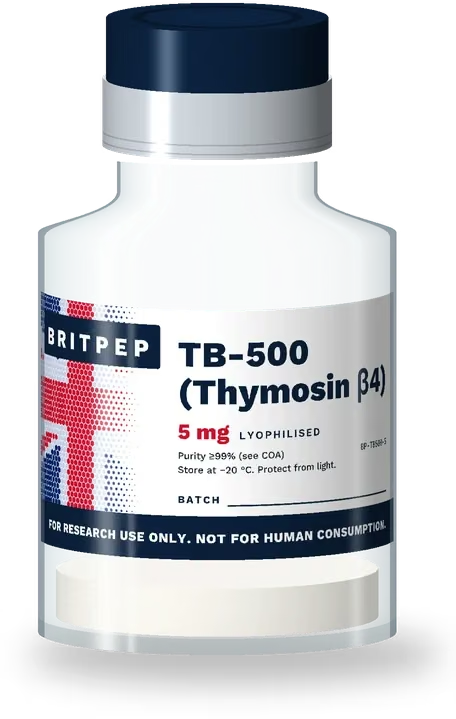
The name TB-500 is used commercially for two different materials: synthetic full-length Tβ4, and short fragments containing the actin-binding motif LKKTETQ (residues 17–23). At least one registered clinical trial record uses “TB-500” for the 17–23 fragment. Because the name does not define the compound, the identity of any material sold as TB-500 should be confirmed from its certificate of analysis – the observed mass immediately distinguishes a ~4.96 kDa full-length peptide from a heptapeptide.
This matters scientifically. A 2010 paper mapped biological activities of Tβ4 to short active sites: the LKKTETQ region has been linked to actin binding, cell migration and angiogenesis in vitro, and the N-terminal Ac-SDKP tetrapeptide to other activities [4]. Results obtained with full-length Tβ4 cannot be assumed to apply to a fragment, or the reverse [4].
Published models
Cell migration. Tβ4 increased keratinocyte and endothelial migration in Boyden-chamber assays, and was studied in a rat full-thickness dermal wound model [6].
Cardiac models. In mouse cardiac models, Tβ4 formed a complex with PINCH and integrin-linked kinase (ILK), leading to Akt activation and effects on cardiomyocyte migration and survival [5].
Clinical development. Investigational full-length Tβ4 formulations have been studied in Phase 2 trials in dry eye [7] and in venous stasis ulcers [8]; in the venous-ulcer study the safety profile was reported as comparable to placebo [8]. Thymosin β4 is not an approved medicine in the UK, the US or the EU, and no peer-reviewed clinical data were identified for the short TB-500 fragment.
From bench to clinical development
The ocular-surface programme illustrates how full-length Tβ4 moved from laboratory work into clinical trials. A 2018 review traces the development of an investigational Tβ4 ophthalmic formulation (RGN-259) from preclinical models of the ocular surface to clinical studies [11]. Two Phase 2 randomised trials in dry eye have been published: one in severe dry eye [7] and one using the controlled adverse environment (CAE) model [12].
In dermal ulcers, a European prospective, randomised, placebo-controlled dose-escalation study in venous stasis ulcers reported on safety and tolerability [13][8].
These trials used specific investigational formulations of the full-length peptide under clinical-trial conditions. Their results say nothing about research materials sold under the TB-500 name, particularly where that name denotes a fragment [4].
Analytical considerations for full-length Tβ4
At 43 residues, full-length Tβ4 is a long sequence for chemical synthesis. Deletion sequences – peptides missing one residue because a coupling or deprotection step was incomplete – are among the most common impurities in synthetic peptides, and in a long sequence they elute close to the main peak. A well-resolved chromatogram, ideally with LC–MS assignment of the minor peaks, is therefore particularly informative for this material; our purity testing guide explains why.
The N-terminal acetyl group is also part of the native structure. An acetylated and a non-acetylated peptide differ by 42 Da, which mass spectrometry resolves easily. Separately, the N-terminal Ac-SDKP tetrapeptide is itself studied as a distinct bioactive sequence [4], so the presence of short N-terminal fragments in a sample would be relevant to interpretation.
Not to be confused with thymosin α1
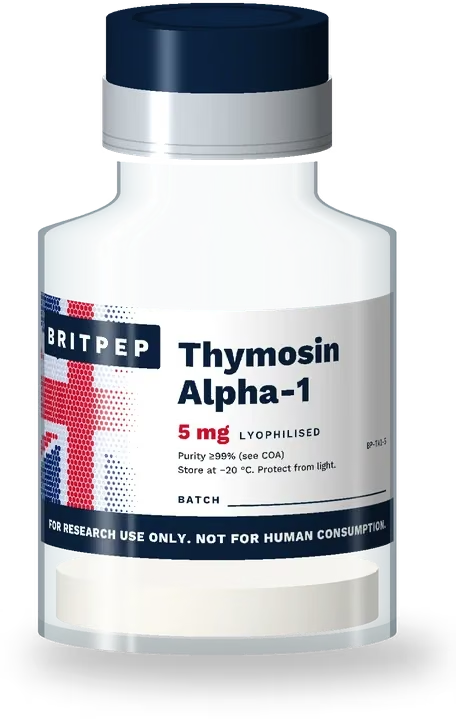
Despite the shared name, thymosin α1 is an entirely different molecule: a 28-residue N-acetylated peptide (Ac-SDAAVDTSSEITTKDLKEKKEVVEEAEN) first characterised from thymus tissue in 1977 and studied mainly for immunomodulatory activity [9]. Thymosin α1 has been studied in large clinical trials – the TESTS randomised trial, for example, found no clear evidence of reduced 28-day mortality in sepsis [10] – and as thymalfasin it is authorised in some countries outside the UK. Research-grade material is not a medicine.
Practical notes for laboratories
- Confirm identity by mass. Full-length Tβ4 (C212H350N56O78S, about 4963 g/mol) and the 17–23 fragment are trivially distinguished by mass spectrometry.
- Watch for oxidation. Full-length Tβ4 contains a methionine residue (Met6).
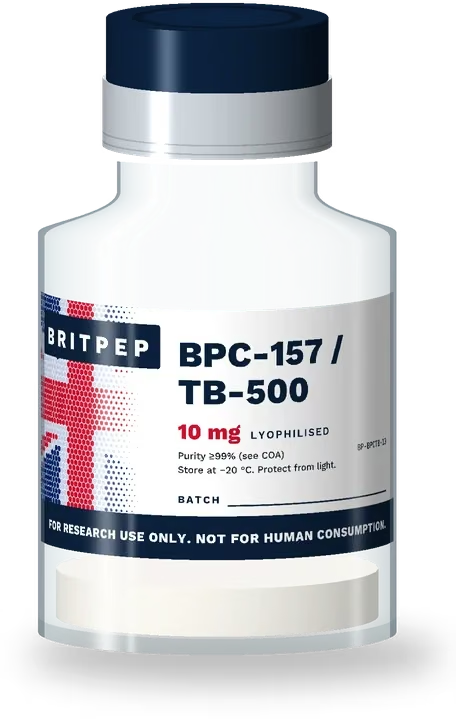
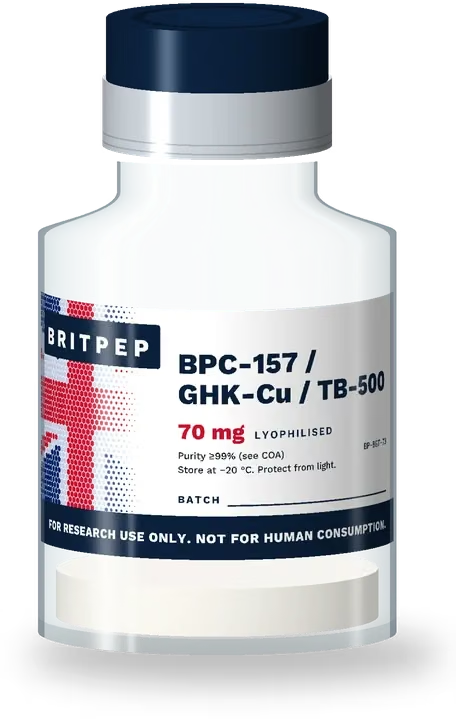
- Blends. Multi-component research blends containing TB-500 should identify each component and its form on the certificate.
- Choose comparators. Experiments on fragments benefit from including full-length Tβ4, and vice versa [4].
Britpep supplies TB-500, thymosin α1 and related materials for laboratory research use only. They are not for human or veterinary use and are sold without dosing or administration guidance. See also our overview of BPC-157, which is often supplied in combination research blends with TB-500.
References
- Cassimeris L, Safer D, Nachmias VT et al.. Thymosin beta 4 sequesters the majority of G-actin in resting human polymorphonuclear leukocytes. J Cell Biol. 1992; 119:1261-70. doi:10.1083/jcb.119.5.1261. PubMed 1447300
- Goldstein AL, Hannappel E, Kleinman HK. Thymosin beta4: actin-sequestering protein moonlights to repair injured tissues. Trends Mol Med. 2005; 11:421-9. doi:10.1016/j.molmed.2005.07.004. PubMed 16099219
- Goldstein AL, Kleinman HK. Advances in the basic and clinical applications of thymosin β4. Expert Opin Biol Ther. 2015; 15 Suppl 1:S139-45. doi:10.1517/14712598.2015.1011617. PubMed 26096726
- Sosne G, Qiu P, Goldstein AL et al.. Biological activities of thymosin beta4 defined by active sites in short peptide sequences. FASEB J. 2010; 24:2144-51. doi:10.1096/fj.09-142307. PubMed 20179146
- Bock-Marquette I, Saxena A, White MD et al.. Thymosin beta4 activates integrin-linked kinase and promotes cardiac cell migration, survival and cardiac repair. Nature. 2004; 432:466-72. doi:10.1038/nature03000. PubMed 15565145
- Malinda KM, Sidhu GS, Mani H et al.. Thymosin beta4 accelerates wound healing. J Invest Dermatol. 1999; 113:364-8. doi:10.1046/j.1523-1747.1999.00708.x. PubMed 10469335
- Sosne G, Dunn SP, Kim C. Thymosin β4 significantly improves signs and symptoms of severe dry eye in a phase 2 randomized trial. Cornea. 2015; 34:491-6. doi:10.1097/ICO.0000000000000379. PubMed 25826322
- Guarnera G, DeRosa A, Camerini R et al.. The effect of thymosin treatment of venous ulcers. Ann N Y Acad Sci. 2010; 1194:207-12. doi:10.1111/j.1749-6632.2010.05490.x. PubMed 20536470
- Garaci E. Thymosin alpha1: a historical overview. Ann N Y Acad Sci. 2007; 1112:14-20. doi:10.1196/annals.1415.039. PubMed 17567941
- Wu J, Pei F, Zhou L et al.. The efficacy and safety of thymosin α1 for sepsis (TESTS): multicentre, double blinded, randomised, placebo controlled, phase 3 trial. BMJ. 2025; 388:e082583. doi:10.1136/bmj-2024-082583. PubMed 39814420
- Sosne G. Thymosin beta 4 and the eye: the journey from bench to bedside. Expert Opin Biol Ther. 2018; 18:99-104. doi:10.1080/14712598.2018.1486818. PubMed 30063853
- Sosne G, Ousler GW. Thymosin beta 4 ophthalmic solution for dry eye: a randomized, placebo-controlled, Phase II clinical trial conducted using the controlled adverse environment (CAE™) model. Clin Ophthalmol. 2015; 9:877-84. doi:10.2147/OPTH.S80954. PubMed 26056426
- Guarnera G, DE Rosa A, Camerini R. Thymosin beta-4 and venous ulcers: clinical remarks on a European prospective, randomized study on safety, tolerability, and enhancement on healing. Ann N Y Acad Sci. 2007; 1112:407-12. doi:10.1196/annals.1415.003. PubMed 17495250
References were checked against PubMed and official UK sources at the time of writing. Summaries describe what each source reports; they are not claims about Britpep products.