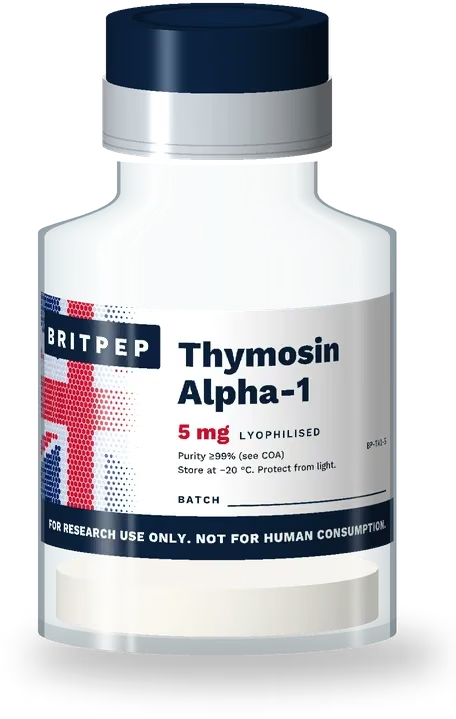
Thymosin Alpha-1
N-acetylated 28-residue thymic peptide, used in immunology research.
Prepared to order · approx. 7 days + Royal Mail Tracked 24
SKU BP-TA1-5 · ≥99% (see COA) · Lyophilised powder
Note: Salt form (e.g. acetate or TFA) and net peptide content to be confirmed from the supplier COA. Authorised as a medicine (thymalfasin) outside the UK; the client's solicitor has advised that it holds no UK marketing authorisation.
Thymosin Alpha-1 overview
Thymosin α1 is a 28-residue N-terminally acetylated peptide first isolated from thymic tissue (thymosin fraction 5). It is supplied as a lyophilised solid for in-vitro laboratory research.
Thymosin Alpha-1 research background
Evidence status: Findings summarised here include clinical-trial data; this compound has a regulatory status as a medicine in some countries outside the UK, which does not apply to this research-grade product. They are not established effects in humans, have not been evaluated by the MHRA, and are provided for scientific context only. This product is supplied strictly for laboratory research and is not for human or veterinary use.
Established research
Peer-reviewed published findings, with referencesOverview & discovery history
- Thymosin α1 is a 28-amino-acid N-acetylated peptide, first characterised from thymus by Allan Goldstein in 1977 [1]. As thymalfasin, it is authorised as a medicine in a number of countries outside the UK [2]. It does not have a UK marketing authorisation, and this research-grade product is not a medicine.
Chemical identity
Identity values are confirmed per lot on the certificate of analysis. Salt/counter-ion form (e.g. acetate or TFA) is stated on the COA where applicable.
Mechanisms investigated
Research areas & model types
Human clinical research status
Safety observations reported in studies
- Reviews describe wide clinical use. Questions about dosing schedules and endpoints remain [6].
Storage & handling for laboratory use
Store at −20 °C. Protect from light.
Store lyophilised material sealed at −20 °C or below, protected from light and moisture. Allow the vial to equilibrate to room temperature before opening to limit condensation.
- Allow the sealed vial to reach room temperature before opening to limit condensation.
- Any solutions should be prepared only for in-vitro laboratory work under your own validated protocol; aliquoting limits repeated freeze–thaw cycles.
- Handle with standard laboratory PPE in line with your risk assessment and the Safety Data Sheet (SDS). Britpep does not provide preparation or administration guidance.
Emerging & theoretical
Unconfirmed — hypotheses & ongoing researchThese are unconfirmed hypotheses and early-stage lines of enquiry, not established effects. Not evaluated by the MHRA. Not for human or veterinary use.
Hypotheses proposed by researchers
- Researchers have proposed new mechanisms involving proteostasis [3].
Registered clinical studies (ongoing or unpublished)
- NCT05086614 — Phase 3 trial as an adjuvant after colorectal cancer resection (sponsor: Fudan University).
- NCT06821100 — Phase 1 study on vaccine response in older adults (sponsor: The Methodist Hospital).
- NCT07866118 — Mechanistic study in sepsis-associated immunosuppression (sponsor: Zhongshan Hospital).
Registry entries checked on ClinicalTrials.gov on 24 October 2026; status as listed by the sponsor. Registration does not imply results or efficacy.
Preprints: none included (no relevant preprint could be verified). Anecdotal, user-reported or social-media material is deliberately excluded.
References
- Garaci E. Thymosin alpha1: a historical overview. Ann N Y Acad Sci. 2007. PubMed 17567941 · doi:10.1196/annals.1415.039
- Goldstein AL, Goldstein AL. From lab to bedside: emerging clinical applications of thymosin alpha 1. Expert Opin Biol Ther. 2009. PubMed 19392576 · doi:10.1517/14712590902911412
- Stincardini C, Renga G, Villella V et al.. Cellular proteostasis: a new twist in the action of thymosin α1. Expert Opin Biol Ther. 2018. PubMed 30063867 · doi:10.1080/14712598.2018.1484103
- Wu J, Pei F, Zhou L et al.. The efficacy and safety of thymosin α1 for sepsis (TESTS): multicentre, double blinded, randomised, placebo controlled, phase 3 trial. BMJ. 2025. PubMed 39814420 · doi:10.1136/bmj-2024-082583
- Gu B, Zhou Y, Nie Y et al.. Efficacy of thymosin α1 for sepsis: a systematic review and meta-analysis of randomized controlled trials. Front Cell Infect Microbiol. 2025. PubMed 40969554 · doi:10.3389/fcimb.2025.1673959
- Camerini R, Garaci E. Historical review of thymosin α 1 in infectious diseases. Expert Opin Biol Ther. 2015. PubMed 26098768 · doi:10.1517/14712598.2015.1033393
- Chien RN, Liaw YF. Thymalfasin for the treatment of chronic hepatitis B. Expert Rev Anti Infect Ther. 2004. PubMed 15482167 · doi:10.1586/14787210.2.1.9
Every reference was checked against PubMed (NCBI) before publication. Summaries describe published research only and are not claims of any effect in humans or animals.
Certificates of analysis
[No batch COA published yet. The certificate for each lot will be listed here and in the COA checker before release.]