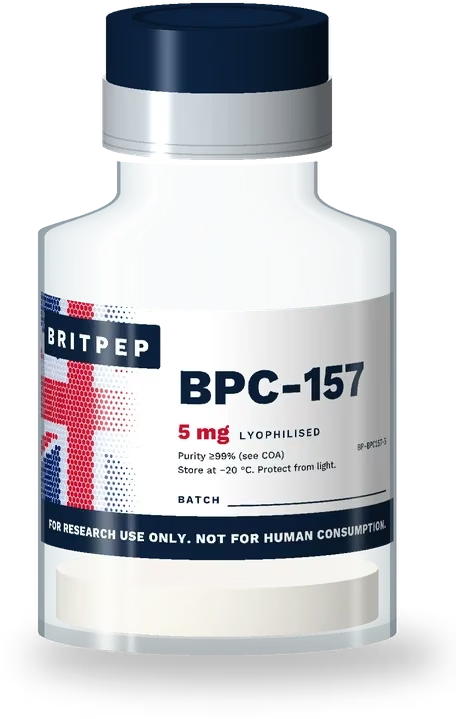
Identity and sequence
BPC-157 is a synthetic linear peptide of fifteen amino acids: Gly-Glu-Pro-Pro-Pro-Gly-Lys-Pro-Ala-Asp-Asp-Ala-Gly-Leu-Val (one-letter code GEPPPGKPADDAGLV). Its molecular formula is C62H98N16O22 and its average molecular weight is approximately 1419.5 g/mol. Because it is made by chemical synthesis, a research lot is characterised in the same way as any other synthetic peptide: identity is confirmed by mass spectrometry against the calculated mass, and purity is estimated by reversed-phase HPLC.
The name stands for “body protection compound”. The sequence was described as a partial sequence of a larger protein isolated from gastric juice, which is why papers often call it a “stable gastric pentadecapeptide” [1][3]. The full parent protein is not what researchers buy or study today; published experimental work uses the synthetic fifteen-residue fragment.
The peptide is supplied for laboratory work as a lyophilised (freeze-dried) solid. It is not an approved medicine in the UK, the US or the EU. A 2025 literature and patent review notes that it has not been approved by the FDA or other regulators because of insufficient clinical study [4].
Where the research comes from
A striking feature of the BPC-157 literature is how concentrated it is. Most of the published work comes from a single research group in Zagreb, and independent reviewers have repeatedly pointed out that replication by unrelated laboratories is limited [1][2]. That matters for anyone planning experiments: findings that have only been reported by one group are best treated as hypotheses to be tested rather than settled facts.
Most studies have been carried out in rodent models, with a smaller body of cell-culture work [3][4]. The subject areas covered include gastrointestinal models, musculoskeletal soft-tissue models (tendon and ligament), vascular models, and central nervous system models. A 2022 review of the central nervous system work notes that it, too, largely originates from the same group [10].
Mechanisms that have been proposed
No single molecular target or receptor for BPC-157 has been established. Instead, the literature describes interactions with several signalling systems, each reported in a limited number of experimental settings:
Nitric-oxide system. A series of rodent studies examined how BPC-157 interacts with modulators of the nitric-oxide system such as L-NAME and L-arginine [5].
VEGFR2–Akt–eNOS signalling. In endothelial cell culture and a rat hind-limb ischaemia model, BPC-157 was reported to up-regulate VEGFR2 expression and promote its internalisation, with downstream changes in Akt and eNOS signalling [6]. This is one of the more frequently cited mechanistic papers because it came from a group outside Zagreb.
FAK–paxillin and the cytoskeleton. In cultured tendon fibroblasts, BPC-157 was reported to increase phosphorylation of focal adhesion kinase (FAK) and paxillin and to increase F-actin formation, consistent with effects on cell spreading and migration in vitro [7].
Tendocyte culture. An earlier study reported that BPC-157 opposed the growth-inhibiting effect of 4-hydroxynonenal in cultured tendocytes, alongside work in a rat Achilles-tendon transection model [8].
Each of these observations comes from a small number of papers. Researchers designing mechanistic studies typically include appropriate controls for peptide identity, counter-ion and vehicle, because these can all influence cell-culture readouts.
Experimental models in the literature
Reviews group the published BPC-157 studies into a handful of model systems [1][3][4]:
- Tendon and ligament models – rat Achilles-tendon transection and tendon-fibroblast culture [7][8], summarised in a 2019 review of musculoskeletal soft-tissue research [1].
- Angiogenesis and vascular models – the chick chorioallantoic membrane assay, endothelial tube formation and rat hind-limb ischaemia [6].
- Gastrointestinal and NO-system models – reviewed by the originating group [3][5].
- Central nervous system models – rodent studies reviewed in [10].
When reading these papers it is worth noting the route, formulation and source of peptide used, the size of each experimental group, and whether outcome assessment was blinded. These details vary considerably between studies and are often the first thing reviewers comment on.
What the reviews conclude
Recent independent reviews are cautious. A 2025 systematic review in orthopaedic sports medicine found only level IV–V evidence in humans – case series and similar reports – and did not find clinical safety data [9]. A 2025 narrative review reached a similar view, emphasising that human data are minimal and that material obtained from non-regulated sources carries contamination and quality risks [2]. No completed, published randomised controlled trial of BPC-157 was identified in these reviews.
Reviews also note that preclinical studies in animals have described few adverse findings, but that formal toxicology and pharmacokinetic data are limited [2][9]. The unknown molecular target, the dominance of one research group and the absence of controlled human studies are the three limitations most often listed.
Practical notes for laboratories
For in-vitro and other laboratory work, the quality of the starting material is the variable a researcher can control most directly. Useful checks include confirming that the observed mass on the certificate of analysis matches the calculated monoisotopic or average mass for GEPPPGKPADDAGLV, that the HPLC purity figure refers to the same lot number printed on the vial, and that the counter-ion (often acetate or trifluoroacetate) is recorded. Our guide to reading a peptide certificate of analysis covers these points in more detail.
BPC-157 is also supplied in multi-component research blends. A blend is a different research material from the single peptide: each component should be identified on the certificate, and results obtained with a blend cannot be attributed to any one component without separate experiments.
Britpep supplies BPC-157 strictly for laboratory research use only. It is not for human or veterinary use, and we do not provide any guidance on administration or dosing.
References
- Gwyer D, Wragg NM, Wilson SL. Gastric pentadecapeptide body protection compound BPC 157 and its role in accelerating musculoskeletal soft tissue healing. Cell Tissue Res. 2019; 377:153-159. doi:10.1007/s00441-019-03016-8. PubMed 30915550
- McGuire FP, Martinez R, Lenz A et al.. Regeneration or Risk? A Narrative Review of BPC-157 for Musculoskeletal Healing. Curr Rev Musculoskelet Med. 2025; 18:611-619. doi:10.1007/s12178-025-09990-7. PubMed 40789979
- Seiwerth S, Rucman R, Turkovic B et al.. BPC 157 and Standard Angiogenic Growth Factors. Gastrointestinal Tract Healing, Lessons from Tendon, Ligament, Muscle and Bone Healing. Curr Pharm Des. 2018; 24:1972-1989. doi:10.2174/1381612824666180712110447. PubMed 29998800
- Józwiak M, Bauer M, Kamysz W et al.. Multifunctionality and Possible Medical Application of the BPC 157 Peptide-Literature and Patent Review. Pharmaceuticals (Basel). 2025; 18. doi:10.3390/ph18020185. PubMed 40005999
- Sikiric P, Seiwerth S, Rucman R et al.. Stable gastric pentadecapeptide BPC 157-NO-system relation. Curr Pharm Des. 2014; 20:1126-35. doi:10.2174/13816128113190990411. PubMed 23755725
- Hsieh MJ, Liu HT, Wang CN et al.. Therapeutic potential of pro-angiogenic BPC157 is associated with VEGFR2 activation and up-regulation. J Mol Med (Berl). 2017; 95:323-333. doi:10.1007/s00109-016-1488-y. PubMed 27847966
- Chang CH, Tsai WC, Lin MS et al.. The promoting effect of pentadecapeptide BPC 157 on tendon healing involves tendon outgrowth, cell survival, and cell migration. J Appl Physiol (1985). 2011; 110:774-80. doi:10.1152/japplphysiol.00945.2010. PubMed 21030672
- Staresinic M, Sebecic B, Patrlj L et al.. Gastric pentadecapeptide BPC 157 accelerates healing of transected rat Achilles tendon and in vitro stimulates tendocytes growth. J Orthop Res. 2003; 21:976-83. doi:10.1016/S0736-0266(03)00110-4. PubMed 14554208
- Vasireddi N, Hahamyan H, Salata MJ et al.. Emerging Use of BPC-157 in Orthopaedic Sports Medicine: A Systematic Review. HSS J. 2025; 21:485-495. doi:10.1177/15563316251355551. PubMed 40756949
- Vukojevic J, Milavić M, Perović D et al.. Pentadecapeptide BPC 157 and the central nervous system. Neural Regen Res. 2022; 17:482-487. doi:10.4103/1673-5374.320969. PubMed 34380875
References were checked against PubMed and official UK sources at the time of writing. Summaries describe what each source reports; they are not claims about Britpep products.