
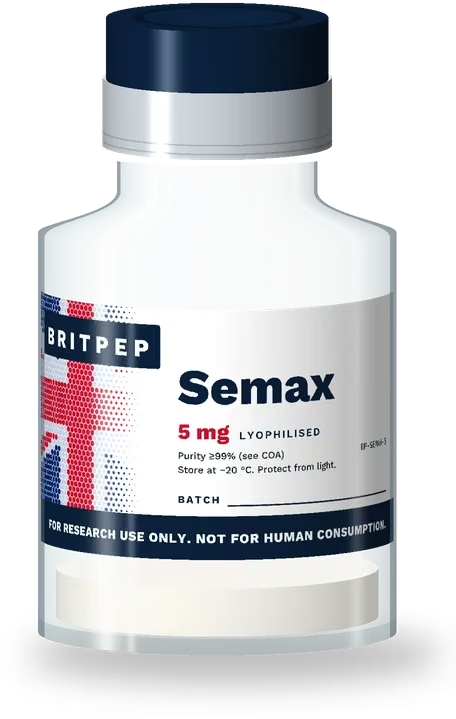
Semax
Synthetic heptapeptide analogue of the ACTH(4–7) fragment extended with Pro-Gly-Pro, used in neuropeptide research.
Prepared to order · approx. 7 days + Royal Mail Tracked 24
SKU BP-SEMAX-5 · ≥99% (see COA) · Lyophilised powder
Note: Salt form (e.g. acetate) and counter-ion content to be confirmed from the supplier COA.
Semax overview
Semax is a synthetic heptapeptide made of the adrenocorticotropic hormone fragment ACTH(4–7) (Met-Glu-His-Phe) joined to a C-terminal Pro-Gly-Pro sequence. It is supplied as a lyophilised solid for in-vitro laboratory research.
Semax research background
Evidence status: Findings summarised here come largely from preclinical research and small clinical studies published mainly by Russian research groups, often in Russian-language journals. They are not established effects in humans, have not been evaluated by the MHRA, and are provided for scientific context only. This product is supplied strictly for laboratory research and is not for human or veterinary use.
Established research
Peer-reviewed published findings, with referencesOverview & discovery history
Chemical identity
Identity values are confirmed per lot on the certificate of analysis. Salt/counter-ion form (e.g. acetate or TFA) is stated on the COA where applicable.
Mechanisms investigated
Research areas & model types
Human clinical research status
Safety observations reported in studies
- The Russian clinical reports did not describe major safety concerns, but the studies were small and not always randomised [6].
Known limitations
- There is limited independent, non-Russian replication, and the clinical evidence comes mostly from small studies.
Storage & handling for laboratory use
Store at −20 °C. Protect from light.
Store lyophilised material sealed at −20 °C or below, protected from light and moisture. Allow the vial to equilibrate to room temperature before opening to limit condensation.
- Allow the sealed vial to reach room temperature before opening to limit condensation.
- Any solutions should be prepared only for in-vitro laboratory work under your own validated protocol; aliquoting limits repeated freeze–thaw cycles.
- Handle with standard laboratory PPE in line with your risk assessment and the Safety Data Sheet (SDS). Britpep does not provide preparation or administration guidance.
Emerging & theoretical
Unconfirmed — hypotheses & ongoing researchThese are unconfirmed hypotheses and early-stage lines of enquiry, not established effects. Not evaluated by the MHRA. Not for human or veterinary use.
Hypotheses proposed by researchers
- Researchers have proposed that Semax's effects are mediated in part by modulating neurotrophin (BDNF/TrkB) expression [1][3].
Open scientific questions
- What is the identity of the specific Semax binding site?
Preprints: none included (no relevant preprint could be verified). Anecdotal, user-reported or social-media material is deliberately excluded.
References
- Dolotov OV, Karpenko EA, Seredenina TS et al.. Semax, an analogue of adrenocorticotropin (4-10), binds specifically and increases levels of brain-derived neurotrophic factor protein in rat basal forebrain. J Neurochem. 2006. PubMed 16635254 · doi:10.1111/j.1471-4159.2006.03658.x
- Eremin KO, Kudrin VS, Saransaari P et al.. Semax, an ACTH(4-10) analogue with nootropic properties, activates dopaminergic and serotoninergic brain systems in rodents. Neurochem Res. 2005. PubMed 16362768 · doi:10.1007/s11064-005-8826-8
- Dmitrieva VG, Povarova OV, Skvortsova VI et al.. Semax and Pro-Gly-Pro activate the transcription of neurotrophins and their receptor genes after cerebral ischemia. Cell Mol Neurobiol. 2010. PubMed 19633950 · doi:10.1007/s10571-009-9432-0
- Medvedeva EV, Dmitrieva VG, Povarova OV et al.. The peptide semax affects the expression of genes related to the immune and vascular systems in rat brain focal ischemia: genome-wide transcriptional analysis. BMC Genomics. 2014. PubMed 24661604 · doi:10.1186/1471-2164-15-228
- Sudarkina OY, Filippenkov IB, Stavchansky VV et al.. Brain Protein Expression Profile Confirms the Protective Effect of the ACTH((4-7))PGP Peptide (Semax) in a Rat Model of Cerebral Ischemia-Reperfusion. Int J Mol Sci. 2021. PubMed 34201112 · doi:10.3390/ijms22126179
- Gusev EI, Martynov MY, Kostenko EV et al.. [The efficacy of semax in the tretament of patients at different stages of ischemic stroke]. Zh Nevrol Psikhiatr Im S S Korsakova. 2018. PubMed 29798983 · doi:10.17116/jnevro20181183261-68
- Gusev EI, Skvortsova VI, Miasoedov NF et al.. [Effectiveness of semax in acute period of hemispheric ischemic stroke (a clinical and electrophysiological study)]. Zh Nevrol Psikhiatr Im S S Korsakova. 1997. PubMed 11517472
- Grivennikov IA, Dolotov OV, Zolotarev YA et al.. Effects of behaviorally active ACTH (4-10) analogue - Semax on rat basal forebrain cholinergic neurons. Restor Neurol Neurosci. 2008. PubMed 18431004
Every reference was checked against PubMed (NCBI) before publication. Summaries describe published research only and are not claims of any effect in humans or animals.
Certificates of analysis
[No batch COA published yet. The certificate for each lot will be listed here and in the COA checker before release.]
Related research compounds
Browse similar compounds: Neuropeptide research peptides, Cell-signalling research peptides or the full catalogue.