
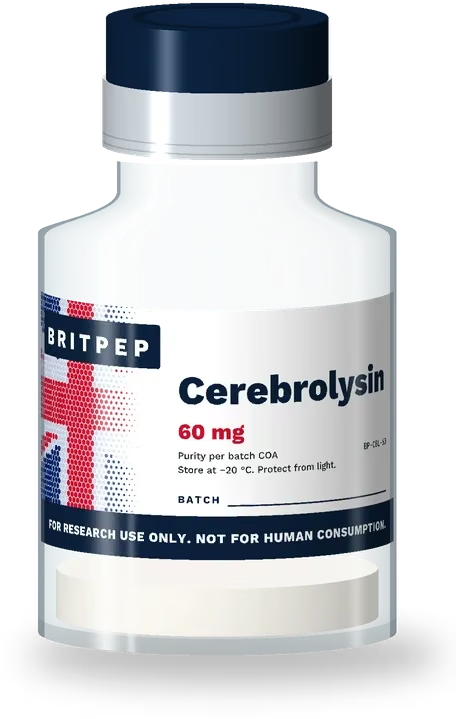
Cerebrolysin
Mixture of low-molecular-weight peptides and amino acids derived from porcine brain protein, used in neurotrophic-signalling research.
Prepared to order · approx. 7 days + Royal Mail Tracked 24
SKU BP-CBL-60 · per batch COA · To be confirmed [TO VERIFY against supplier COA]
Note: Animal-derived (porcine) material. Supplier pack is 6 vials, not 10. Physical form, source documentation and composition must be confirmed with the supplier. Authorised as a medicine outside the UK; the client's solicitor has advised that it holds no UK marketing authorisation. Purity specification to be confirmed against the supplier COA.
Cerebrolysin overview
Cerebrolysin is a preparation of low-molecular-weight peptides and free amino acids produced by standardised enzymatic breakdown of purified porcine brain proteins. The supplier lists it as 60 mg per vial in packs of 6. Its physical form (lyophilised or solution) is to be confirmed [TO VERIFY against supplier COA]. Supplied for in-vitro laboratory research only.
Cerebrolysin research background
Evidence status: Findings summarised here include clinical-trial data; this compound has a regulatory status as a medicine in some countries outside the UK, which does not apply to this research-grade product. They are not established effects in humans, have not been evaluated by the MHRA, and are provided for scientific context only. This product is supplied strictly for laboratory research and is not for human or veterinary use.
Established research
Peer-reviewed published findings, with referencesOverview & discovery history
- Cerebrolysin is a mixture of low-molecular-weight peptides and amino acids derived from porcine brain proteins. It has been studied for neurotrophic-like activity [1][2]. It is used clinically in several countries outside the UK, but it does not hold a UK marketing authorisation, and this research-grade product is not a medicine.
Chemical identity
Identity values are confirmed per lot on the certificate of analysis. Salt/counter-ion form (e.g. acetate or TFA) is stated on the COA where applicable.
Mechanisms investigated
Research areas & model types
Human clinical research status
Safety observations reported in studies
- Non-fatal serious adverse events may be increased, according to the Cochrane stroke review [4].
Known limitations
- It is an undefined mixture, and the trials carry a high risk of bias [5].
Storage & handling for laboratory use
Store at −20 °C. Protect from light.
Store lyophilised material sealed at −20 °C or below, protected from light and moisture. Allow the vial to equilibrate to room temperature before opening to limit condensation.
- Allow the sealed vial to reach room temperature before opening to limit condensation.
- Any solutions should be prepared only for in-vitro laboratory work under your own validated protocol; aliquoting limits repeated freeze–thaw cycles.
- Handle with standard laboratory PPE in line with your risk assessment and the Safety Data Sheet (SDS). Britpep does not provide preparation or administration guidance.
Emerging & theoretical
Unconfirmed — hypotheses & ongoing researchThese are unconfirmed hypotheses and early-stage lines of enquiry, not established effects. Not evaluated by the MHRA. Not for human or veterinary use.
Hypotheses proposed by researchers
- Researchers have proposed a multimodal 'neurotrophic' mechanism [1].
Registered clinical studies (ongoing or unpublished)
- NCT05755997 — Phase 2 trial in CADASIL (sponsor: Ever Neuro Pharma). Listed as active, not recruiting.
- NCT06339411 — Phase 2 trial after thrombectomy (sponsor: Chang Gung Memorial Hospital).
- NCT06897176 — Phase 4 study in post-stroke aphasia (sponsor: Yonsei University).
Registry entries checked on ClinicalTrials.gov on 24 October 2026; status as listed by the sponsor. Registration does not imply results or efficacy.
Preprints: none included (no relevant preprint could be verified). Anecdotal, user-reported or social-media material is deliberately excluded.
References
- Rejdak K, Sienkiewicz-Jarosz H, Bienkowski P et al.. Modulation of neurotrophic factors in the treatment of dementia, stroke and TBI: Effects of Cerebrolysin. Med Res Rev. 2023. PubMed 37052231 · doi:10.1002/med.21960
- Mureșanu DF, Livinț Popa L, Chira D et al.. Role and Impact of Cerebrolysin for Ischemic Stroke Care. J Clin Med. 2022. PubMed 35268364 · doi:10.3390/jcm11051273
- Lombardi VR, Windisch M, García M et al.. Effects of Cerebrolysin on in vitro primary microglial and astrocyte rat cell cultures. Methods Find Exp Clin Pharmacol. 1999. PubMed 10420388 · doi:10.1358/mf.1999.21.5.541910
- Ziganshina LE, Abakumova T, Nurkhametova D et al.. Cerebrolysin for acute ischaemic stroke. Cochrane Database Syst Rev. 2023. PubMed 37818733 · doi:10.1002/14651858.CD007026.pub7
- Cui S, Chen N, Yang M et al.. Cerebrolysin for vascular dementia. Cochrane Database Syst Rev. 2019. PubMed 31710397 · doi:10.1002/14651858.CD008900.pub3
- Gauthier S, Proaño JV, Jia J et al.. Cerebrolysin in mild-to-moderate Alzheimer's disease: a meta-analysis of randomized controlled clinical trials. Dement Geriatr Cogn Disord. 2015. PubMed 25832905 · doi:10.1159/000377672
Every reference was checked against PubMed (NCBI) before publication. Summaries describe published research only and are not claims of any effect in humans or animals.
Certificates of analysis
[No batch COA published yet. The certificate for each lot will be listed here and in the COA checker before release.]
Related research compounds
Browse similar compounds: Neuropeptide research peptides or the full catalogue.