
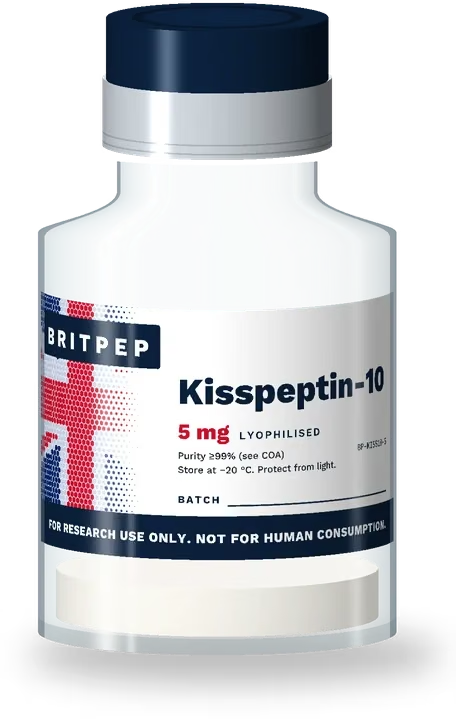
Kisspeptin-10
C-terminal decapeptide of kisspeptin, used in KISS1R (GPR54) receptor research.
Prepared to order · approx. 7 days + Royal Mail Tracked 24
SKU BP-KISS10-5 · ≥99% (see COA) · Lyophilised powder
Note: Salt form (e.g. acetate or TFA) and net peptide content to be confirmed from the supplier COA.
Kisspeptin-10 overview
Kisspeptin-10 is the C-terminal 10-residue fragment (112–121) of the KISS1 gene product. It is the minimal sequence that retains full activity at the kisspeptin receptor. It is supplied as a lyophilised solid for in-vitro laboratory research.
Kisspeptin-10 research background
Evidence status: Findings summarised here come from preclinical research and small, early-phase human studies. They are not established effects in humans, have not been evaluated by the MHRA, and are provided for scientific context only. This product is supplied strictly for laboratory research and is not for human or veterinary use.
Established research
Peer-reviewed published findings, with referencesOverview & discovery history
- Kisspeptin-10 is the C-terminal decapeptide (residues 112–121) of kisspeptin, which is encoded by the KISS1 gene. Kisspeptins were identified in 2001 as ligands of the orphan receptor GPR54 (now KISS1R) [1][2]. Loss-of-function mutations in GPR54 were found to cause hypogonadotropic hypogonadism [3][4].
Chemical identity
Identity values are confirmed per lot on the certificate of analysis. Salt/counter-ion form (e.g. acetate or TFA) is stated on the COA where applicable.
Mechanisms investigated
Research areas & model types
Human clinical research status
- Kisspeptin peptides are used as research tools in human reproductive physiology. Kisspeptin is not an approved medicine [6].
Safety observations reported in studies
Known limitations
- The human studies are short physiological studies [8].
Storage & handling for laboratory use
Store at −20 °C. Protect from light.
Store lyophilised material sealed at −20 °C or below, protected from light and moisture. Allow the vial to equilibrate to room temperature before opening to limit condensation.
- Allow the sealed vial to reach room temperature before opening to limit condensation.
- Any solutions should be prepared only for in-vitro laboratory work under your own validated protocol; aliquoting limits repeated freeze–thaw cycles.
- Handle with standard laboratory PPE in line with your risk assessment and the Safety Data Sheet (SDS). Britpep does not provide preparation or administration guidance.
Emerging & theoretical
Unconfirmed — hypotheses & ongoing researchThese are unconfirmed hypotheses and early-stage lines of enquiry, not established effects. Not evaluated by the MHRA. Not for human or veterinary use.
Hypotheses proposed by researchers
- Reviewers have proposed kisspeptin-based approaches as potential future tools in reproductive medicine [6][5].
Registered clinical studies (ongoing or unpublished)
- NCT07224490 — Phase 1 study using kisspeptin 112–121 to probe GnRH neuronal function (sponsor: Massachusetts General Hospital).
- NCT05896293 — Phase 2 study of kisspeptin in hypogonadotropic hypogonadism (sponsor: Massachusetts General Hospital).
- NCT07224438 — Phase 2 study of kisspeptin in hypothalamic amenorrhoea (sponsor: Massachusetts General Hospital).
Registry entries checked on ClinicalTrials.gov on 24 October 2026; status as listed by the sponsor. Registration does not imply results or efficacy.
Preprints: none included (no relevant preprint could be verified). Anecdotal, user-reported or social-media material is deliberately excluded.
References
- Ohtaki T, Shintani Y, Honda S et al.. Metastasis suppressor gene KiSS-1 encodes peptide ligand of a G-protein-coupled receptor. Nature. 2001. PubMed 11385580 · doi:10.1038/35079135
- Kotani M, Detheux M, Vandenbogaerde A et al.. The metastasis suppressor gene KiSS-1 encodes kisspeptins, the natural ligands of the orphan G protein-coupled receptor GPR54. J Biol Chem. 2001. PubMed 11457843 · doi:10.1074/jbc.M104847200
- de Roux N, Genin E, Carel JC et al.. Hypogonadotropic hypogonadism due to loss of function of the KiSS1-derived peptide receptor GPR54. Proc Natl Acad Sci U S A. 2003. PubMed 12944565 · doi:10.1073/pnas.1834399100
- Seminara SB, Messager S, Chatzidaki EE et al.. The GPR54 gene as a regulator of puberty. N Engl J Med. 2003. PubMed 14573733 · doi:10.1056/NEJMoa035322
- Koysombat K, Tsoutsouki J, Patel AH et al.. Kisspeptin and neurokinin B: roles in reproductive health. Physiol Rev. 2025. PubMed 39813600 · doi:10.1152/physrev.00015.2024
- Mills EG, Dhillo WS. Invited review: Translating kisspeptin and neurokinin B biology into new therapies for reproductive health. J Neuroendocrinol. 2022. PubMed 36262016 · doi:10.1111/jne.13201
- George JT, Veldhuis JD, Roseweir AK et al.. Kisspeptin-10 is a potent stimulator of LH and increases pulse frequency in men. J Clin Endocrinol Metab. 2011. PubMed 21632807 · doi:10.1210/jc.2011-0089
- George JT, Anderson RA, Millar RP. Kisspeptin-10 stimulation of gonadotrophin secretion in women is modulated by sex steroid feedback. Hum Reprod. 2012. PubMed 22956346 · doi:10.1093/humrep/des326
Every reference was checked against PubMed (NCBI) before publication. Summaries describe published research only and are not claims of any effect in humans or animals.
Certificates of analysis
[No batch COA published yet. The certificate for each lot will be listed here and in the COA checker before release.]
Related research compounds
VIP (vasoactive intestinal peptide)
AOD9604
Adamax
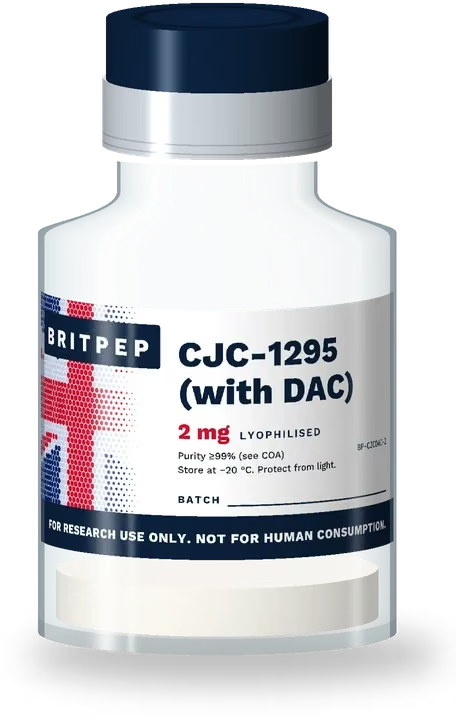
CJC-1295 (with DAC)
Browse similar compounds: Neuropeptide research peptides, Endocrine & receptor-signalling research peptides or the full catalogue.