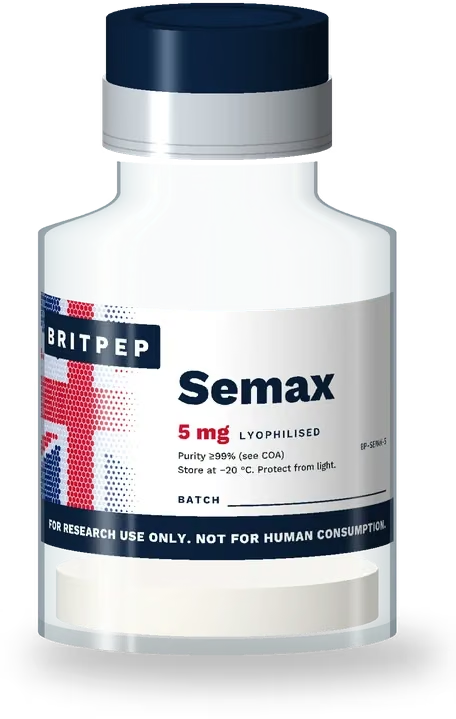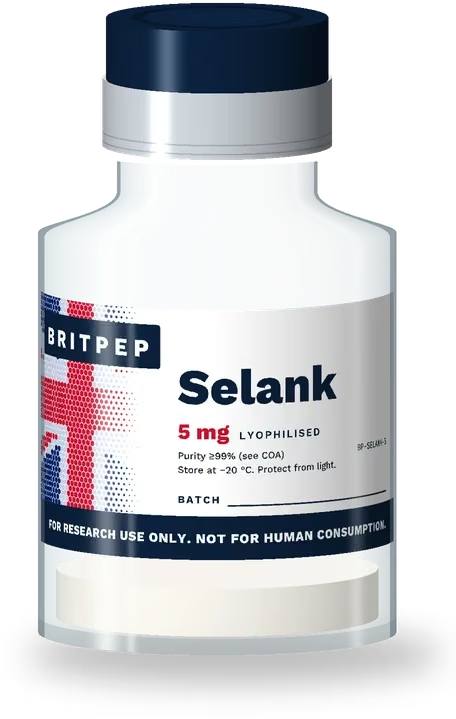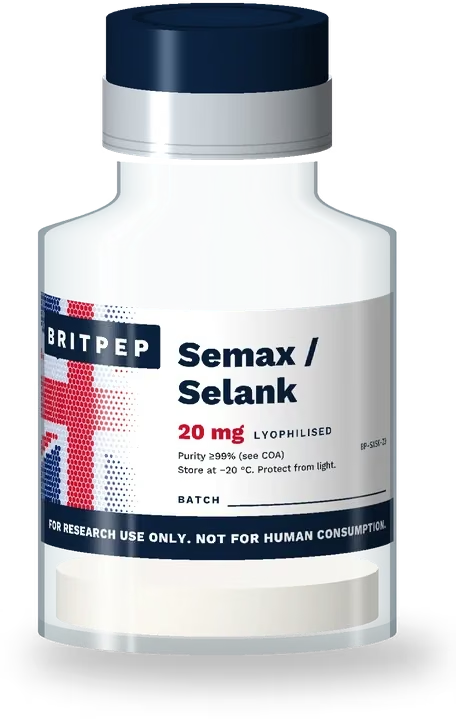
A shared design: active fragment plus Pro-Gly-Pro
Both peptides are heptapeptides built from a short, biologically active parent sequence extended at the C-terminus with Pro-Gly-Pro (PGP). The PGP extension is described as increasing stability compared with the parent fragment [1][5]. Both were developed in Russia, and most of their literature comes from Russian institutions.
- Semax – Met-Glu-His-Phe-Pro-Gly-Pro (MEHFPGP), molecular formula C37H51N9O10S. It joins the ACTH(4–7) fragment to PGP and is described as an analogue of ACTH(4–10) [1][2].
- Selank – Thr-Lys-Pro-Arg-Pro-Gly-Pro (TKPRPGP), molecular formula C33H57N11O9. It extends tuftsin (Thr-Lys-Pro-Arg), an immunomodulatory tetrapeptide, with PGP [5][6].
The parent peptides
ACTH(4–10) is a fragment of adrenocorticotropic hormone (ACTH), the 39-residue pituitary hormone. Short ACTH fragments that lack the sequence needed for adrenal steroidogenic activity were studied for their effects in the central nervous system, and Semax was developed from that line of research as a stabilised analogue [1][2].
Tuftsin (Thr-Lys-Pro-Arg) is an endogenous tetrapeptide described as immunomodulatory. Selank extends it with Pro-Gly-Pro, and a 2003 paper discusses Selank alongside other short peptides of the tuftsin family [6].
Because both drugs share the PGP tail, PGP itself has been studied as a comparator – for example in the ischaemia gene-transcription study that examined Semax and PGP together [3].
Semax in the literature
Neurotrophin signalling. A 2006 study reported specific binding sites for Semax in rat basal forebrain and increased levels of brain-derived neurotrophic factor (BDNF) protein [1]. Later work in rat models of cerebral ischaemia examined transcription of neurotrophins and their receptor genes [3], and a genome-wide transcriptional analysis described effects on genes related to the immune and vascular systems in focal ischaemia [4].
Neurotransmitter systems. In rodents, Semax was reported to activate dopaminergic and serotoninergic brain systems [2].
Clinical context. Clinical studies of Semax have been published in Russian journals. Semax is not authorised as a medicine in the UK, the EU or the US, and there is limited independent replication of the published work outside Russia.
Selank in the literature
GABAergic transmission. Studies have reported changes in the expression of genes involved in GABAergic neurotransmission after Selank administration in rats [7], and in IMR-32 neuroblastoma cells treated with GABA, Selank or olanzapine [9]. Allosteric modulation of GABAA receptors has been proposed as a mechanism in a 2018 review [5].
Enkephalin-degrading enzymes. Inhibition of enzymes that degrade enkephalins was reported in 2001 [8].
Tuftsin family. A 2003 paper placed Selank among short peptides of the tuftsin family studied in rodent behavioural models [6].
Imaging. A small placebo-controlled study examined resting-state functional connectivity with Selank and Semax [10].
Selank is not authorised as a medicine in the UK, the EU or the US. As with Semax, the research comes mostly from Russian groups, and the available clinical reports are small.
Reading this literature critically
Three points are worth bearing in mind. First, much of the work has been published in Russian-language journals or by a small number of collaborating groups, so independent replication is limited. Second, many studies report gene-expression changes, which identify candidate pathways but do not by themselves establish a mechanism. Third, PGP-extended peptides can be cleaved to shorter fragments, including PGP itself; one ischaemia study examined Semax and PGP side by side [3]. Experimental designs that include the parent fragment and PGP as comparators help separate these contributions.
For analytical work, Semax and Selank are small enough that identity is straightforward to confirm by mass spectrometry. Semax contains a methionine residue, which is susceptible to oxidation in storage – see our storage guide.
Analytical profile
- Semax: 7 residues, C37H51N9O10S, approximately 813.9 g/mol as the free base. Contains one methionine (oxidation-sensitive) and one histidine.
- Selank: 7 residues, C33H57N11O9, approximately 751.9 g/mol as the free base. Contains lysine and arginine, so it is strongly basic and is often supplied as an acetate salt.
Both peptides are short enough that a well-resolved reversed-phase HPLC chromatogram and an ESI mass spectrum together give a clear picture of identity and purity. Because supplied salt forms vary, the molecular weight used for concentration calculations should be taken from the lot-specific certificate rather than the free-base figure. Our guide to reading a certificate of analysis explains the difference between gross weight and peptide content.
Combined research materials
A Semax/Selank research blend combines two distinct peptides in one vial. The certificate of analysis for a blend should identify both components; any experimental observation made with a mixture cannot be attributed to either peptide without separate controls.
Britpep supplies Semax, Selank and the combined material for laboratory research use only. They are not for human or veterinary use and are sold without any dosing or administration guidance. Browse the neuropeptide research collection for related compounds.
References
- Dolotov OV, Karpenko EA, Seredenina TS et al.. Semax, an analogue of adrenocorticotropin (4-10), binds specifically and increases levels of brain-derived neurotrophic factor protein in rat basal forebrain. J Neurochem. 2006; 97 Suppl 1:82-6. doi:10.1111/j.1471-4159.2006.03658.x. PubMed 16635254
- Eremin KO, Kudrin VS, Saransaari P et al.. Semax, an ACTH(4-10) analogue with nootropic properties, activates dopaminergic and serotoninergic brain systems in rodents. Neurochem Res. 2005; 30:1493-500. doi:10.1007/s11064-005-8826-8. PubMed 16362768
- Dmitrieva VG, Povarova OV, Skvortsova VI et al.. Semax and Pro-Gly-Pro activate the transcription of neurotrophins and their receptor genes after cerebral ischemia. Cell Mol Neurobiol. 2010; 30:71-9. doi:10.1007/s10571-009-9432-0. PubMed 19633950
- Medvedeva EV, Dmitrieva VG, Povarova OV et al.. The peptide semax affects the expression of genes related to the immune and vascular systems in rat brain focal ischemia: genome-wide transcriptional analysis. BMC Genomics. 2014; 15:228. doi:10.1186/1471-2164-15-228. PubMed 24661604
- Vyunova TV, Andreeva L, Shevchenko K et al.. Peptide-based Anxiolytics: The Molecular Aspects of Heptapeptide Selank Biological Activity. Protein Pept Lett. 2018; 25:914-923. doi:10.2174/0929866525666180925144642. PubMed 30255741
- Kozlovskaya MM, Kozlovskii II, Val'dman EA et al.. Selank and short peptides of the tuftsin family in the regulation of adaptive behavior in stress. Neurosci Behav Physiol. 2003; 33:853-60. doi:10.1023/a:1025988519919. PubMed 14969422
- Volkova A, Shadrina M, Kolomin T et al.. Selank Administration Affects the Expression of Some Genes Involved in GABAergic Neurotransmission. Front Pharmacol. 2016; 7:31. doi:10.3389/fphar.2016.00031. PubMed 26924987
- Zozulya AA, Kost NV, Yu Sokolov O et al.. The inhibitory effect of Selank on enkephalin-degrading enzymes as a possible mechanism of its anxiolytic activity. Bull Exp Biol Med. 2001; 131:315-7. doi:10.1023/a:1017979514274. PubMed 11550013
- Filatova E, Kasian A, Kolomin T et al.. GABA, Selank, and Olanzapine Affect the Expression of Genes Involved in GABAergic Neurotransmission in IMR-32 Cells. Front Pharmacol. 2017; 8:89. doi:10.3389/fphar.2017.00089. PubMed 28293190
- Panikratova YR, Lebedeva IS, Sokolov OY et al.. Functional Connectomic Approach to Studying Selank and Semax Effects. Dokl Biol Sci. 2020; 490:9-11. doi:10.1134/S001249662001007X. PubMed 32342318
References were checked against PubMed and official UK sources at the time of writing. Summaries describe what each source reports; they are not claims about Britpep products.