
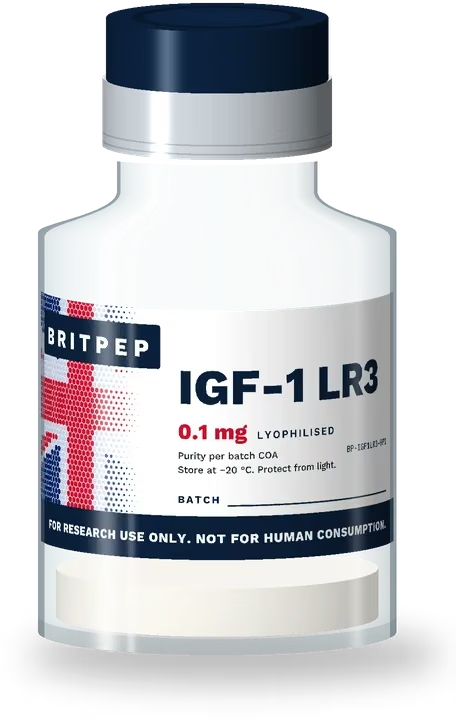
IGF-1 LR3
Long-R3 analogue of insulin-like growth factor 1 with reduced IGF-binding-protein affinity, widely used in cell-culture research.
Prepared to order · approx. 7 days + Royal Mail Tracked 24
SKU BP-IGF1LR3-0P1 · per batch COA · Lyophilised powder
Note: Recombinant protein: expression system and endotoxin level should be confirmed from the supplier COA. Purity specification to be confirmed against the supplier COA.
IGF-1 LR3 overview
IGF-1 LR3 is an 83-residue recombinant analogue of human IGF-1, with a 13-residue N-terminal extension and an Arg substitution at position 3 (Glu3Arg) of the IGF-1 sequence. It is supplied as a lyophilised solid for in-vitro laboratory research.
IGF-1 LR3 research background
Evidence status: Findings summarised here come from published cell-culture and animal research; Long R3 IGF-I is established mainly as a cell-culture supplement. They are not established effects in humans, have not been evaluated by the MHRA, and are provided for scientific context only. This product is supplied strictly for laboratory research and is not for human or veterinary use.
Established research
Peer-reviewed published findings, with referencesOverview & discovery history
Chemical identity
Identity values are confirmed per lot on the certificate of analysis. Salt/counter-ion form (e.g. acetate or TFA) is stated on the COA where applicable.
Mechanisms investigated
Research areas & model types
Human clinical research status
- No human clinical trials were identified. It is not an approved medicine.
Safety observations reported in studies
- In pigs it suppressed plasma GH and endogenous IGF-I [3]. No human safety data exist.
Known limitations
- The evidence is mainly from cell culture and livestock.
Storage & handling for laboratory use
Store at −20 °C. Protect from light.
Store lyophilised material sealed at −20 °C or below, protected from light and moisture. Allow the vial to equilibrate to room temperature before opening to limit condensation.
- Allow the sealed vial to reach room temperature before opening to limit condensation.
- Any solutions should be prepared only for in-vitro laboratory work under your own validated protocol; aliquoting limits repeated freeze–thaw cycles.
- Handle with standard laboratory PPE in line with your risk assessment and the Safety Data Sheet (SDS). Britpep does not provide preparation or administration guidance.
Emerging & theoretical
Unconfirmed — hypotheses & ongoing researchThese are unconfirmed hypotheses and early-stage lines of enquiry, not established effects. Not evaluated by the MHRA. Not for human or veterinary use.
Hypotheses proposed by researchers
- No credible additional hypotheses beyond the established biochemistry were identified.
Preprints: none included (no relevant preprint could be verified). Anecdotal, user-reported or social-media material is deliberately excluded.
References
- King R, Wells JR, Krieg P et al.. Production and characterization of recombinant insulin-like growth factor-I (IGF-I) and potent analogues of IGF-I, with Gly or Arg substituted for Glu3, following their expression in Escherichia coli as fusion proteins. J Mol Endocrinol. 1992. PubMed 1311930 · doi:10.1677/jme.0.0080029
- Francis GL, Ross M, Ballard FJ et al.. Novel recombinant fusion protein analogues of insulin-like growth factor (IGF)-I indicate the relative importance of IGF-binding protein and receptor binding for enhanced biological potency. J Mol Endocrinol. 1992. PubMed 1378742 · doi:10.1677/jme.0.0080213
- Dunaiski V, Dunshea FR, Walton PE et al.. Long [R3] insulin-like growth factor-I reduces growth, plasma growth hormone, IGF binding protein-3 and endogenous IGF-I concentrations in pigs. J Endocrinol. 1997. PubMed 9488001 · doi:10.1677/joe.0.1550559
- Xi G, Kamanga-Sollo E, Pampusch MS et al.. Effect of recombinant porcine IGFBP-3 on IGF-I and long-R3-IGF-I-stimulated proliferation and differentiation of L6 myogenic cells. J Cell Physiol. 2004. PubMed 15254966 · doi:10.1002/jcp.20068
- Prelle K, Stojkovic M, Boxhammer K et al.. Insulin-like growth factor I (IGF-I) and long R(3)IGF-I differently affect development and messenger ribonucleic acid abundance for IGF-binding proteins and type I IGF receptors in in vitro produced bovine embryos. Endocrinology. 2001. PubMed 11181549 · doi:10.1210/endo.142.3.8038
Every reference was checked against PubMed (NCBI) before publication. Summaries describe published research only and are not claims of any effect in humans or animals.
Certificates of analysis
[No batch COA published yet. The certificate for each lot will be listed here and in the COA checker before release.]
Related research compounds
Browse similar compounds: Endocrine & receptor-signalling research peptides, Cell-signalling research peptides or the full catalogue.