
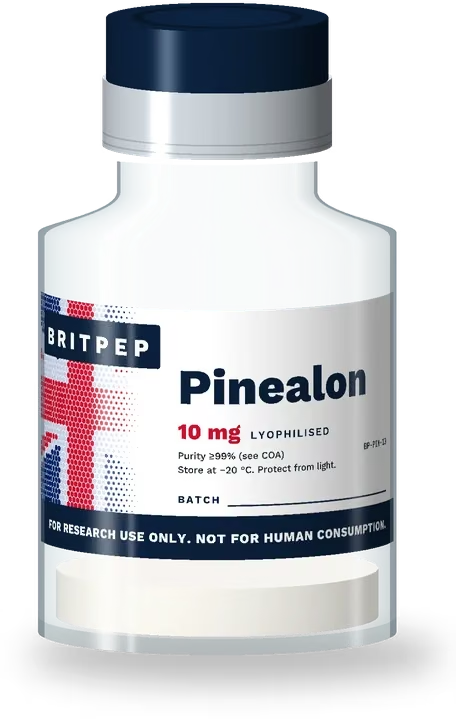
Pinealon
Synthetic tripeptide Glu-Asp-Arg used in neuronal cell-culture research.
Prepared to order · approx. 7 days + Royal Mail Tracked 24
SKU BP-PIN-10 · ≥99% (see COA) · Lyophilised powder
Pinealon overview
Pinealon is a synthetic tripeptide. It is supplied as a lyophilised solid for in-vitro research.
Pinealon research background
Evidence status: Little peer-reviewed research is publicly available for this compound. They are not established effects in humans, have not been evaluated by the MHRA, and are provided for scientific context only. This product is supplied strictly for laboratory research and is not for human or veterinary use.
Established research
Peer-reviewed published findings, with referencesOverview & discovery history
- Pinealon (Glu-Asp-Arg, EDR) is a synthetic tripeptide from the Khavinson group of 'short regulatory peptides'. Little peer-reviewed research is publicly available, and most of it comes from this group [1].
Chemical identity
Identity values are confirmed per lot on the certificate of analysis. Salt/counter-ion form (e.g. acetate or TFA) is stated on the COA where applicable.
Mechanisms investigated
Research areas & model types
Human clinical research status
- No registered or peer-reviewed controlled clinical trials were identified. It is not an approved medicine.
Safety observations reported in studies
- No formal safety studies were identified.
Known limitations
- The literature is small and from a single group, with no independent replication.
Storage & handling for laboratory use
Store at −20 °C. Protect from light.
Store lyophilised material sealed at −20 °C or below, protected from light and moisture. Allow the vial to equilibrate to room temperature before opening to limit condensation.
- Allow the sealed vial to reach room temperature before opening to limit condensation.
- Any solutions should be prepared only for in-vitro laboratory work under your own validated protocol; aliquoting limits repeated freeze–thaw cycles.
- Handle with standard laboratory PPE in line with your risk assessment and the Safety Data Sheet (SDS). Britpep does not provide preparation or administration guidance.
Emerging & theoretical
Unconfirmed — hypotheses & ongoing researchThese are unconfirmed hypotheses and early-stage lines of enquiry, not established effects. Not evaluated by the MHRA. Not for human or veterinary use.
Hypotheses proposed by researchers
- The originating researchers hypothesise that EDR enters cells and binds histones or nucleic acids to regulate gene expression, including genes relevant to Alzheimer's-disease models. This remains a proposal [1].
Open scientific questions
- Does it bind DNA or histones in cells, and with what specificity?
Preprints: none included (no relevant preprint could be verified). Anecdotal, user-reported or social-media material is deliberately excluded.
References
- Khavinson V, Linkova N, Kozhevnikova E et al.. EDR Peptide: Possible Mechanism of Gene Expression and Protein Synthesis Regulation Involved in the Pathogenesis of Alzheimer's Disease. Molecules. 2020. PubMed 33396470 · doi:10.3390/molecules26010159
- Khavinson V, Ribakova Y, Kulebiakin K et al.. Pinealon increases cell viability by suppression of free radical levels and activating proliferative processes. Rejuvenation Res. 2011. PubMed 21978084 · doi:10.1089/rej.2011.1172
- Fedoreyeva LI, Kireev II, Khavinson VKh et al.. Penetration of short fluorescence-labeled peptides into the nucleus in HeLa cells and in vitro specific interaction of the peptides with deoxyribooligonucleotides and DNA. Biochemistry (Mosc). 2011. PubMed 22117547 · doi:10.1134/S0006297911110022
- Arutjunyan A, Kozina L, Stvolinskiy S et al.. Pinealon protects the rat offspring from prenatal hyperhomocysteinemia. Int J Clin Exp Med. 2012. PubMed 22567179
Every reference was checked against PubMed (NCBI) before publication. Summaries describe published research only and are not claims of any effect in humans or animals.
Certificates of analysis
[No batch COA published yet. The certificate for each lot will be listed here and in the COA checker before release.]
Related research compounds
Browse similar compounds: Neuropeptide research peptides or the full catalogue.