Two receptors, two research tools
Growth-hormone (GH) secretion from the anterior pituitary is regulated by hypothalamic GH-releasing hormone (GHRH), which stimulates it, and somatostatin, which inhibits it. A second stimulatory pathway was uncovered by what has been called reverse pharmacology: synthetic GH secretagogues were developed first, their receptor (GHS-R) was then cloned, and the receptor was used to find its endogenous ligand [1]. That ligand, ghrelin, was identified in 1999 as an acylated peptide from the stomach [2].
Research peptides in this area therefore fall into two families: analogues of GHRH acting at the GHRH receptor, and agonists of the ghrelin receptor (GHS-R1a). A 2005 review describes how secretagogues acting at GHS-R can influence GH pulse amplitude through several mechanisms, including amplifying GHRH signalling and opposing somatostatin [1].
GHRH analogues: CJC-1295 and tesamorelin
Native GHRH is a 44-residue peptide, and its first 29 residues – GHRH(1–29) – retain activity. Both CJC-1295 and tesamorelin are modified versions designed to resist degradation.
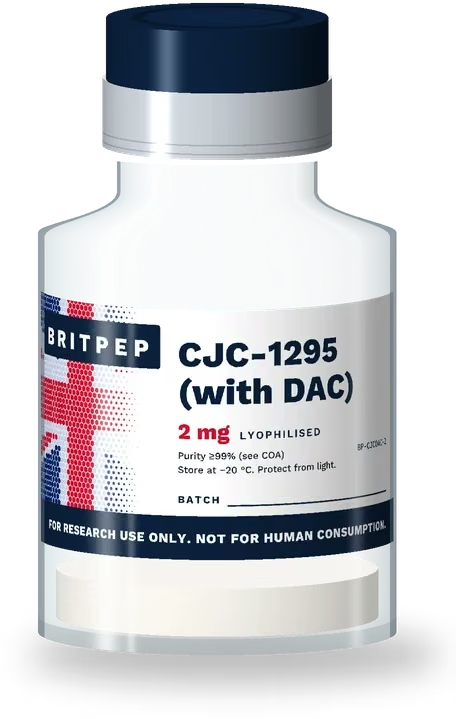
CJC-1295 with DAC is a GHRH(1–29) analogue carrying a “drug affinity complex”: a maleimide-functionalised lysine that binds covalently to serum albumin. In rats, the conjugate was detected in plasma beyond 72 hours and activated the GRF receptor on the anterior pituitary [4]. Studies in healthy adults reported sustained increases in GH and IGF-I [5], and pulsatile GH secretion was preserved during continuous stimulation [6].
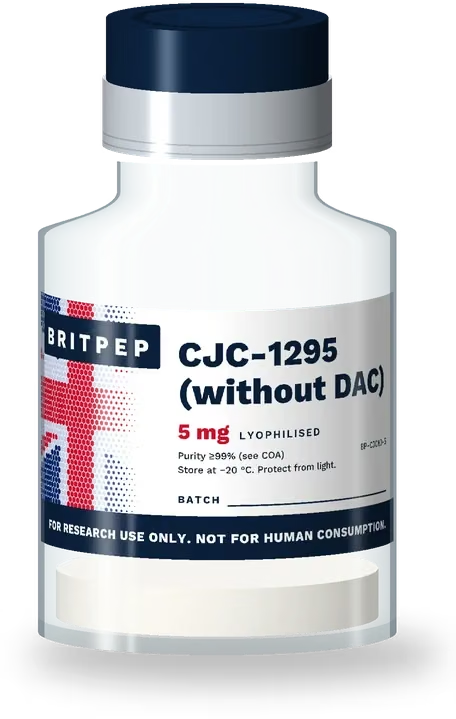
CJC-1295 without DAC (sometimes called modified GRF(1–29)) carries the same four amino-acid substitutions but no albumin-binding group. Little peer-reviewed research is specific to it, and the human studies above concern the DAC version and cannot be assumed to apply. Because the two materials differ only by the terminal modification, the certificate of analysis – observed mass in particular – is the way to confirm which one is in the vial.
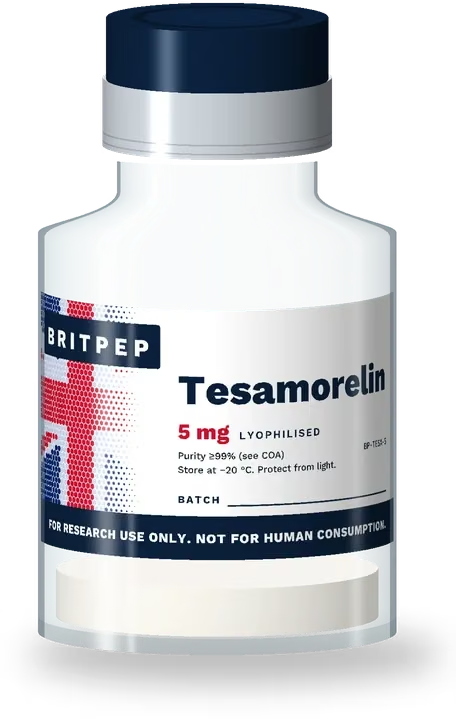
Tesamorelin is full-length GHRH(1–44) with an N-terminal trans-3-hexenoyl group [9]. It has been studied extensively in randomised trials in people with HIV [10], and in the US it has a marketing authorisation in that population [9]. It does not have a UK marketing authorisation, and research-grade tesamorelin is not a medicine.
Ghrelin-receptor agonists: ipamorelin
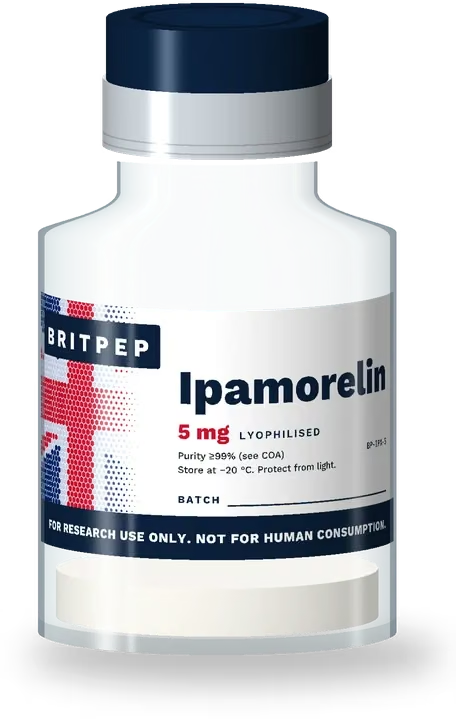
Ipamorelin is a synthetic pentapeptide, Aib-His-D-2-Nal-D-Phe-Lys-NH2, described in 1998 as the first selective GH secretagogue [3]. Its selectivity refers to the observation in animal studies that GH release was not accompanied by the increases in ACTH or cortisol seen with earlier secretagogues [3]. It acts at the receptor that was subsequently shown to be the ghrelin receptor [2].
Pharmacokinetic–pharmacodynamic modelling of ipamorelin has been reported in healthy volunteers [7]. A Phase 2 randomised placebo-controlled study in postoperative ileus after bowel resection found no significant difference from placebo on its primary endpoint [8]. Ipamorelin is not an approved medicine.
Reading the CJC-1295 sequence
Comparing the CJC-1295 backbone with native human GHRH(1–29) shows exactly where it was modified. The native sequence is YADAIFTNSYRKVLGQLSARKLLQDIMSR-NH2. In the CJC-1295 sequence used for both research materials, four positions differ:
- Position 2: L-alanine replaced by D-alanine.
- Position 8: asparagine replaced by glutamine.
- Position 15: glycine replaced by alanine.
- Position 27: methionine replaced by leucine.
From an analytical point of view, two of these changes are directly relevant to handling: replacing methionine removes a residue that is prone to oxidation, and replacing asparagine removes a classic deamidation site. The D-alanine at position 2 does not change the mass, so it cannot be confirmed by mass spectrometry alone – a reminder that stereochemistry is not checked by a simple mass result.
The DAC version adds a lysine carrying a maleimidopropionyl group at the C-terminus, which is the reactive handle for albumin conjugation [4]. That adds several hundred daltons to the mass, so the two CJC-1295 materials are easy to tell apart on a certificate of analysis.
Comparing the materials
- Receptor: CJC-1295 and tesamorelin – GHRH receptor; ipamorelin – GHS-R1a (ghrelin receptor) [1][3].
- Size: ipamorelin is five residues; CJC-1295 is a 29-residue analogue; tesamorelin is 44 residues plus its N-terminal modification.
- Stability strategy: amino-acid substitutions (CJC-1295 without DAC), substitutions plus albumin conjugation (CJC-1295 with DAC) [4], or N-terminal acylation (tesamorelin) [9]; ipamorelin includes non-natural residues (Aib, D-2-Nal, D-Phe) [3].
- Published human data: healthy-volunteer studies for CJC-1295 with DAC [5][6]; PK/PD and Phase 2 data for ipamorelin [7][8]; Phase 3 trials for tesamorelin [10].
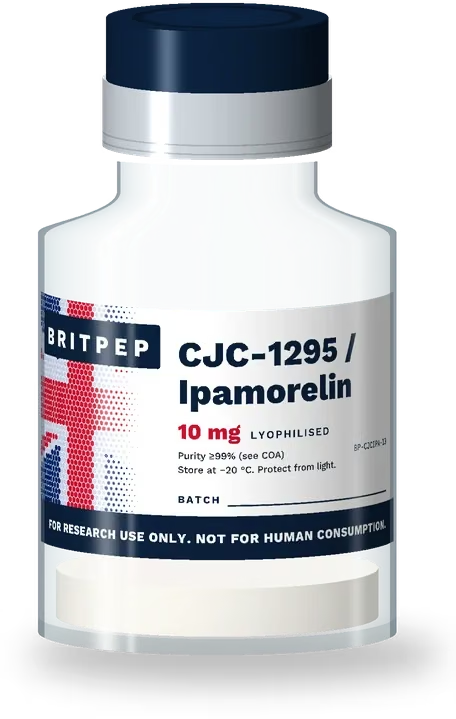
Combination research materials – such as a CJC-1295/ipamorelin blend – contain one agent from each family. Each component should be identified on the certificate of analysis, and observations made with a combination cannot be attributed to either component alone.
Notes for experimental design
Because these peptides act on receptors with well-characterised endogenous ligands, in-vitro work commonly compares them against native GHRH or ghrelin as reference agonists and uses receptor-selective antagonists as controls. Identity checks are particularly important for the CJC-1295 pair, which are easily confused, and for any material described only by a trade name.
All Britpep products in this area are supplied for laboratory research use only, are not for human or veterinary use, and are sold without any dosing or administration guidance. See the endocrine signalling collection for the full list.
References
- Smith RG. Development of growth hormone secretagogues. Endocr Rev. 2005; 26:346-60. doi:10.1210/er.2004-0019. PubMed 15814848
- Kojima M, Hosoda H, Date Y et al.. Ghrelin is a growth-hormone-releasing acylated peptide from stomach. Nature. 1999; 402:656-60. doi:10.1038/45230. PubMed 10604470
- Raun K, Hansen BS, Johansen NL et al.. Ipamorelin, the first selective growth hormone secretagogue. Eur J Endocrinol. 1998; 139:552-61. doi:10.1530/eje.0.1390552. PubMed 9849822
- Jetté L, Léger R, Thibaudeau K et al.. Human growth hormone-releasing factor (hGRF)1-29-albumin bioconjugates activate the GRF receptor on the anterior pituitary in rats: identification of CJC-1295 as a long-lasting GRF analog. Endocrinology. 2005; 146:3052-8. doi:10.1210/en.2004-1286. PubMed 15817669
- Teichman SL, Neale A, Lawrence B et al.. Prolonged stimulation of growth hormone (GH) and insulin-like growth factor I secretion by CJC-1295, a long-acting analog of GH-releasing hormone, in healthy adults. J Clin Endocrinol Metab. 2006; 91:799-805. doi:10.1210/jc.2005-1536. PubMed 16352683
- Ionescu M, Frohman LA. Pulsatile secretion of growth hormone (GH) persists during continuous stimulation by CJC-1295, a long-acting GH-releasing hormone analog. J Clin Endocrinol Metab. 2006; 91:4792-7. doi:10.1210/jc.2006-1702. PubMed 17018654
- Gobburu JV, Agersø H, Jusko WJ et al.. Pharmacokinetic-pharmacodynamic modeling of ipamorelin, a growth hormone releasing peptide, in human volunteers. Pharm Res. 1999; 16:1412-6. doi:10.1023/a:1018955126402. PubMed 10496658
- Beck DE, Sweeney WB, McCarter MD et al.. Prospective, randomized, controlled, proof-of-concept study of the Ghrelin mimetic ipamorelin for the management of postoperative ileus in bowel resection patients. Int J Colorectal Dis. 2014; 29:1527-34. doi:10.1007/s00384-014-2030-8. PubMed 25331030
- Spooner LM, Olin JL. Tesamorelin: a growth hormone-releasing factor analogue for HIV-associated lipodystrophy. Ann Pharmacother. 2012; 46:240-7. doi:10.1345/aph.1Q629. PubMed 22298602
- Falutz J, Allas S, Blot K et al.. Metabolic effects of a growth hormone-releasing factor in patients with HIV. N Engl J Med. 2007; 357:2359-70. doi:10.1056/NEJMoa072375. PubMed 18057338
References were checked against PubMed and official UK sources at the time of writing. Summaries describe what each source reports; they are not claims about Britpep products.