
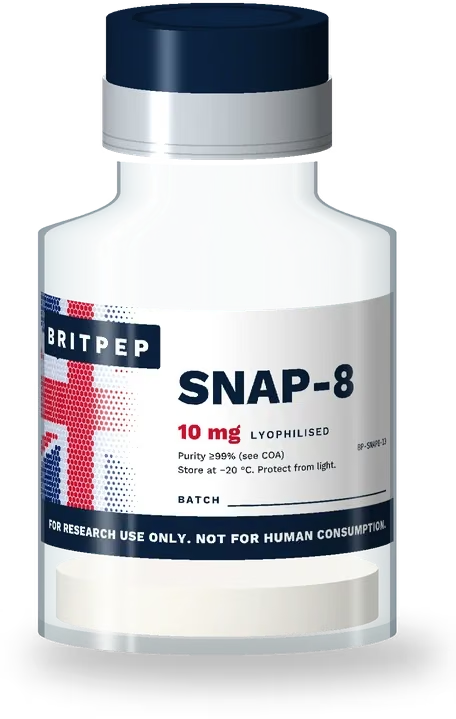
SNAP-8 (Acetyl Octapeptide-3)
Acetylated octapeptide modelled on the N-terminus of SNAP-25, used in cosmetic-science research.
Prepared to order · approx. 7 days + Royal Mail Tracked 24
SKU BP-SNAP8-10 · ≥99% (see COA) · Lyophilised powder
SNAP-8 (Acetyl Octapeptide-3) overview
SNAP-8 (INCI: acetyl octapeptide-3) is an elongated analogue of acetyl hexapeptide-3. It is supplied as a lyophilised solid for in-vitro research.
SNAP-8 (Acetyl Octapeptide-3) research background
Evidence status: Little peer-reviewed research is publicly available for this compound. They are not established effects in humans, have not been evaluated by the MHRA, and are provided for scientific context only. This product is supplied strictly for laboratory research and is not for human or veterinary use.
Established research
Peer-reviewed published findings, with referencesOverview & discovery history
- SNAP-8 (acetyl octapeptide-3) is an elongated analogue of acetyl hexapeptide-3 (Argireline), designed to mimic the N-terminus of SNAP-25. Little peer-reviewed research is publicly available for SNAP-8 itself. The reference below concerns the parent hexapeptide and is included for context only.
Chemical identity
Identity values are confirmed per lot on the certificate of analysis. Salt/counter-ion form (e.g. acetate or TFA) is stated on the COA where applicable.
Mechanisms investigated
- Context (Argireline, not SNAP-8): the related hexapeptide interfered with SNARE-complex formation and inhibited neurotransmitter release in vitro [1]. Whether SNAP-8 behaves identically has not been established in peer-reviewed literature.
Research areas & model types
Human clinical research status
- No clinical trials of SNAP-8 as a single agent were identified. It is not a medicine.
Safety observations reported in studies
- No dedicated peer-reviewed safety studies of SNAP-8 were identified.
Known limitations
- Primary peer-reviewed data on SNAP-8 itself are essentially absent.
Storage & handling for laboratory use
Store at −20 °C. Protect from light.
Store lyophilised material sealed at −20 °C or below, protected from light and moisture. Allow the vial to equilibrate to room temperature before opening to limit condensation.
- Allow the sealed vial to reach room temperature before opening to limit condensation.
- Any solutions should be prepared only for in-vitro laboratory work under your own validated protocol; aliquoting limits repeated freeze–thaw cycles.
- Handle with standard laboratory PPE in line with your risk assessment and the Safety Data Sheet (SDS). Britpep does not provide preparation or administration guidance.
Emerging & theoretical
Unconfirmed — hypotheses & ongoing researchThese are unconfirmed hypotheses and early-stage lines of enquiry, not established effects. Not evaluated by the MHRA. Not for human or veterinary use.
Hypotheses proposed by researchers
- No credible hypotheses beyond the SNARE-mimicry design rationale described above were found in the peer-reviewed literature.
Open scientific questions
- Does the octapeptide inhibit SNARE assembly more or less than the hexapeptide?
Preprints: none included (no relevant preprint could be verified). Anecdotal, user-reported or social-media material is deliberately excluded.
References
- Blanes-Mira C, Clemente J, Jodas G et al.. A synthetic hexapeptide (Argireline) with antiwrinkle activity. Int J Cosmet Sci. 2002. PubMed 18498523 · doi:10.1046/j.1467-2494.2002.00153.x
- Avcil M, Akman G, Klokkers J et al.. Efficacy of bioactive peptides loaded on hyaluronic acid microneedle patches: A monocentric clinical study. J Cosmet Dermatol. 2020. PubMed 31134751 · doi:10.1111/jocd.13009
Every reference was checked against PubMed (NCBI) before publication. Summaries describe published research only and are not claims of any effect in humans or animals.
Certificates of analysis
[No batch COA published yet. The certificate for each lot will be listed here and in the COA checker before release.]
Related research compounds
Browse similar compounds: Neuropeptide research peptides or the full catalogue.