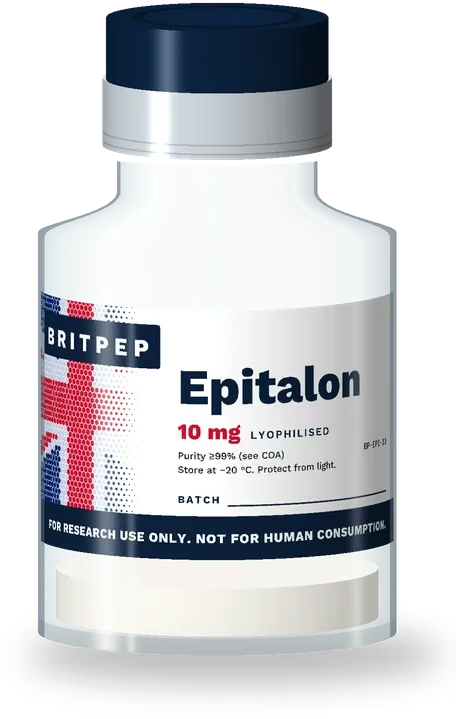
Epitalon
Synthetic tetrapeptide (Ala-Glu-Asp-Gly) used in telomerase and cell-culture research.
Prepared to order · approx. 7 days + Royal Mail Tracked 24
SKU BP-EPI-10 · ≥99% (see COA) · Lyophilised powder
Epitalon overview
Epitalon (also written Epithalon) is a synthetic tetrapeptide. It is supplied as a lyophilised solid for in-vitro research.
Epitalon research background
Evidence status: Findings summarised here come from published research, much of it preclinical (cell or animal), with only very small or uncontrolled human reports. They are not established effects in humans, have not been evaluated by the MHRA, and are provided for scientific context only. This product is supplied strictly for laboratory research and is not for human or veterinary use.
Established research
Peer-reviewed published findings, with referencesOverview & discovery history
- Epitalon (Epithalon, AEDG) is a synthetic tetrapeptide developed in Russia by the group of V. Khavinson. It was designed from the amino-acid composition of epithalamin, a peptide extract of bovine pineal gland [1][2].
- Most published work comes from this group and its collaborators. Note that some older animal studies used epithalamin (the pineal extract), not the synthetic tetrapeptide [3].
Chemical identity
Identity values are confirmed per lot on the certificate of analysis. Salt/counter-ion form (e.g. acetate or TFA) is stated on the COA where applicable.
Mechanisms investigated
- Telomerase: an early study in telomerase-negative human fetal fibroblasts reported induction of the telomerase catalytic subunit and telomere elongation [4]. A 2025 study reported telomere-length extension in human cell lines through hTERT up-regulation (normal cells) or ALT activity (cancer cells) [5].
- Other reported activities include effects on melatonin synthesis, interleukin-2 mRNA and enzyme activities. An overview concluded that it remains uncertain whether these are its sole mechanisms [1].
- Oocyte oxidative stress: in mouse oocytes in vitro, epitalon was reported to reduce intracellular ROS and spindle defects during post-ovulatory ageing [6].
Research areas & model types
Human clinical research status
- A 2026 narrative review states that human evidence is limited to small physiological or biomarker studies and an older controlled study, and that no adequately powered randomised trial has established efficacy [2].
- Epitalon is not an approved medicine in the UK, the US or the EU.
Safety observations reported in studies
- The 2026 review notes that pharmacokinetic, dose-ranging and long-term safety data remain inadequate, and that oncological, immunogenicity and product-quality questions remain unresolved [2].
- Telomerase activation in cells is a recognised theoretical concern in cancer biology. The 2025 cell-line study reported ALT activation in cancer cell lines [5].
Known limitations
Storage & handling for laboratory use
Store at −20 °C. Protect from light.
Store lyophilised material sealed at −20 °C or below, protected from light and moisture. Allow the vial to equilibrate to room temperature before opening to limit condensation.
- Allow the sealed vial to reach room temperature before opening to limit condensation.
- Any solutions should be prepared only for in-vitro laboratory work under your own validated protocol; aliquoting limits repeated freeze–thaw cycles.
- Handle with standard laboratory PPE in line with your risk assessment and the Safety Data Sheet (SDS). Britpep does not provide preparation or administration guidance.
Emerging & theoretical
Unconfirmed — hypotheses & ongoing researchThese are unconfirmed hypotheses and early-stage lines of enquiry, not established effects. Not evaluated by the MHRA. Not for human or veterinary use.
Hypotheses proposed by researchers
- The originating researchers have proposed that short peptides such as AEDG regulate gene expression by interacting with DNA or chromatin. This has not been independently established [1][2].
- Researchers have hypothesised that its effects on telomere maintenance differ between normal and cancer cells (telomerase versus ALT) [5].
Open scientific questions
- Is there a specific molecular target?
- Do the findings replicate independently?
- What are its stability and uptake in cell systems?
Preprints: none included (no relevant preprint could be verified). Anecdotal, user-reported or social-media material is deliberately excluded.
References
- Araj SK, Brzezik J, Mądra-Gackowska K et al.. Overview of Epitalon-Highly Bioactive Pineal Tetrapeptide with Promising Properties. Int J Mol Sci. 2025. PubMed 40141333 · doi:10.3390/ijms26062691
- Jain A, Gallacher DM, Issa MA et al.. Epitalon and Epithalamin: A Narrative Review of Mechanistic, Preclinical, and Clinical Evidence. Int J Mol Sci. 2026. PubMed 42884164 · doi:10.3390/ijms27198922
- Anisimov VN, Mylnikov SV, Khavinson VK. Pineal peptide preparation epithalamin increases the lifespan of fruit flies, mice and rats. Mech Ageing Dev. 1998. PubMed 9701766 · doi:10.1016/s0047-6374(98)00034-7
- Khavinson VKh, Bondarev IE, Butyugov AA. Epithalon peptide induces telomerase activity and telomere elongation in human somatic cells. Bull Exp Biol Med. 2003. PubMed 12937682 · doi:10.1023/a:1025493705728
- Al-Dulaimi S, Thomas R, Matta S et al.. Epitalon increases telomere length in human cell lines through telomerase upregulation or ALT activity. Biogerontology. 2025. PubMed 40908429 · doi:10.1007/s10522-025-10315-x
- Yue X, Liu SL, Guo JN et al.. Epitalon protects against post-ovulatory aging-related damage of mouse oocytes in vitro. Aging (Albany NY). 2022. PubMed 35413689 · doi:10.18632/aging.204007
- Kossoy G, Anisimov VN, Ben-Hur H et al.. Effect of the synthetic pineal peptide epitalon on spontaneous carcinogenesis in female C3H/He mice. In Vivo. 2006. PubMed 16634527
- Anisimov VN, Khavinson VKh, Alimova IN et al.. Epithalon decelerates aging and suppresses development of breast adenocarcinomas in transgenic her-2/neu mice. Bull Exp Biol Med. 2002. PubMed 12459848 · doi:10.1023/a:1021104819170
Every reference was checked against PubMed (NCBI) before publication. Summaries describe published research only and are not claims of any effect in humans or animals.
Certificates of analysis
[No batch COA published yet. The certificate for each lot will be listed here and in the COA checker before release.]