
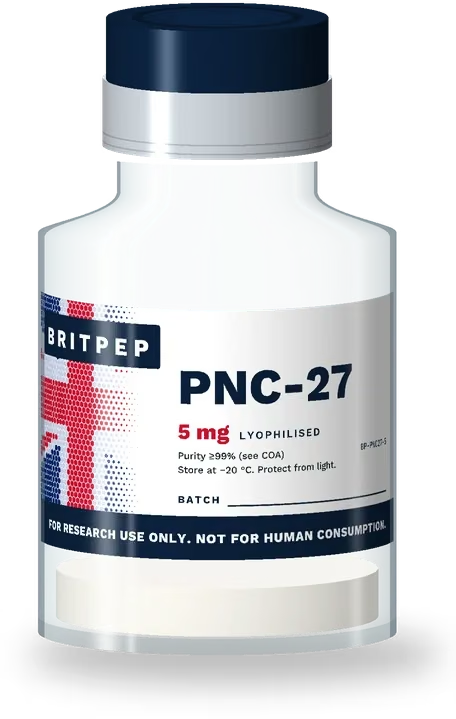
PNC-27
Chimeric peptide (p53-derived HDM-2-binding domain + membrane-penetrating sequence) used in cancer cell-line research.
Prepared to order · approx. 7 days + Royal Mail Tracked 24
SKU BP-PNC27-5 · ≥99% (see COA) · Lyophilised powder
PNC-27 overview
PNC-27 is a 32-residue chimeric peptide that joins an HDM-2-binding sequence from p53 to a cell-penetrating 'penetratin' leader sequence. It is supplied as a lyophilised solid for in-vitro research.
PNC-27 research background
Evidence status: Findings summarised here come from published cell-culture and animal research only; no controlled human studies were identified. They are not established effects in humans, have not been evaluated by the MHRA, and are provided for scientific context only. This product is supplied strictly for laboratory research and is not for human or veterinary use.
Established research
Peer-reviewed published findings, with referencesOverview & discovery history
Chemical identity
Identity values are confirmed per lot on the certificate of analysis. Salt/counter-ion form (e.g. acetate or TFA) is stated on the COA where applicable.
Mechanisms investigated
- Membrane HDM-2 binding: HDM-2 was found in the membranes of various cancer cell lines but not in several untransformed lines, and PNC-27 bound to membrane HDM-2 [1].
- Pore formation ('poptosis'): immuno-electron microscopy showed PNC-27–HDM-2 complexes lining transmembrane pores [3][4].
- Intact-peptide action: lysis was attributed to the whole peptide, not fragments [5].
Research areas & model types
Human clinical research status
- No human trials were identified. It is not an approved medicine.
Safety observations reported in studies
- Selectivity for transformed versus untransformed cells has been reported in vitro [1]. No formal toxicology was identified.
Known limitations
- The research comes largely from one research group.
Storage & handling for laboratory use
Store at −20 °C. Protect from light.
Store lyophilised material sealed at −20 °C or below, protected from light and moisture. Allow the vial to equilibrate to room temperature before opening to limit condensation.
- Allow the sealed vial to reach room temperature before opening to limit condensation.
- Any solutions should be prepared only for in-vitro laboratory work under your own validated protocol; aliquoting limits repeated freeze–thaw cycles.
- Handle with standard laboratory PPE in line with your risk assessment and the Safety Data Sheet (SDS). Britpep does not provide preparation or administration guidance.
Emerging & theoretical
Unconfirmed — hypotheses & ongoing researchThese are unconfirmed hypotheses and early-stage lines of enquiry, not established effects. Not evaluated by the MHRA. Not for human or veterinary use.
Hypotheses proposed by researchers
- Researchers have proposed membrane HDM-2 as a general cancer-cell target for pore-forming peptides [4].
Open scientific questions
- Is membrane HDM-2 expression consistent across tumour types?
Preprints: none included (no relevant preprint could be verified). Anecdotal, user-reported or social-media material is deliberately excluded.
References
- Sarafraz-Yazdi E, Bowne WB, Adler V et al.. Anticancer peptide PNC-27 adopts an HDM-2-binding conformation and kills cancer cells by binding to HDM-2 in their membranes. Proc Natl Acad Sci U S A. 2010. PubMed 20080680 · doi:10.1073/pnas.0909364107
- Pincus MR, Fenelus M, Sarafraz-Yazdi E et al.. Anti-cancer peptides from ras-p21 and p53 proteins. Curr Pharm Des. 2011. PubMed 21728981 · doi:10.2174/138161211797416075
- Sarafraz-Yazdi E, Mumin S, Cheung D et al.. PNC-27, a Chimeric p53-Penetratin Peptide Binds to HDM-2 in a p53 Peptide-like Structure, Induces Selective Membrane-Pore Formation and Leads to Cancer Cell Lysis. Biomedicines. 2022. PubMed 35625682 · doi:10.3390/biomedicines10050945
- Pincus MR, Silberstein M, Zohar N et al.. Poptosis or Peptide-Induced Transmembrane Pore Formation: A Novel Way to Kill Cancer Cells without Affecting Normal Cells. Biomedicines. 2024. PubMed 38927351 · doi:10.3390/biomedicines12061144
- Sookraj KA, Bowne WB, Adler V et al.. The anti-cancer peptide, PNC-27, induces tumor cell lysis as the intact peptide. Cancer Chemother Pharmacol. 2010. PubMed 20182728 · doi:10.1007/s00280-009-1166-7
- Thadi A, Lewis L, Goldstein E et al.. Targeting Membrane HDM-2 by PNC-27 Induces Necrosis in Leukemia Cells But Not in Normal Hematopoietic Cells. Anticancer Res. 2020. PubMed 32878773 · doi:10.21873/anticanres.14488
Every reference was checked against PubMed (NCBI) before publication. Summaries describe published research only and are not claims of any effect in humans or animals.
Certificates of analysis
[No batch COA published yet. The certificate for each lot will be listed here and in the COA checker before release.]